
Pope takes on the Mafia and international corruption

By Christine Duhaime | August 6th, 2017

The Vatican’s justice branch has released its statement emanating from its recent anti-Mafia meeting with global law enforcement agencies to take-down the Mafia around the world through excommunication, if necessary.

The Pope believes that he can make a difference in eradicating the Mafia and transactional criminal organizations through the reach of the Catholic Church.

The Catholic Church has committed to use its reach to address, in particular, countries that are rife with corrupt persons that cause suffering as a result (where for example the rule of law does not prevail).


A new group was established to take on the Mafia and corruption and its goals include:

  • Define the Mafia so that people understand it, and explain the relevance of the rule of law, and in particular the Palermo Convention;
  • Help foster a culture globally of respect for the law;
  • Teach about the consequences of corruption;
  • Envourage International agencies to follow international treaties on corruption and organized crime;
  • Tell the stories of victims of the Mafia and of corruption so that people understand the harm that comes to regular people;
  • Locate and foster relationships with institutions and thought leaders in the space; and
  • Publish magazine, stories, newsletters and hold conferences to address the issues.

On June 15, the International Consultation Group for justice, corruption, organized crime and mafia, part of the Vatican dicastery for Promoting Integral Human Development, organized an International Debate on Corruption. The event, hosted in collaboration with the Pontifical Academy for Social Sciences, drew some 50 participants from all over the world, including anti-mafia and anti-corruption magistrates, bishops, Vatican officials, representatives from the U.N. and various States, heads of movements, victims and ambassadors.

On July 15, 2017, (summarized here), the Pope said that taking down the Mafia and those who support them, is necessary to save humanity.

The reference to the Palermo Convention is among the goals because it is the international treaty dealing with global anti-money laundering law that is the basis for the criminalization of moving, dealing with, accepting etc. proceeds of crime from one country to another, which prohibits banks from wiring proceeds of crime internationally.
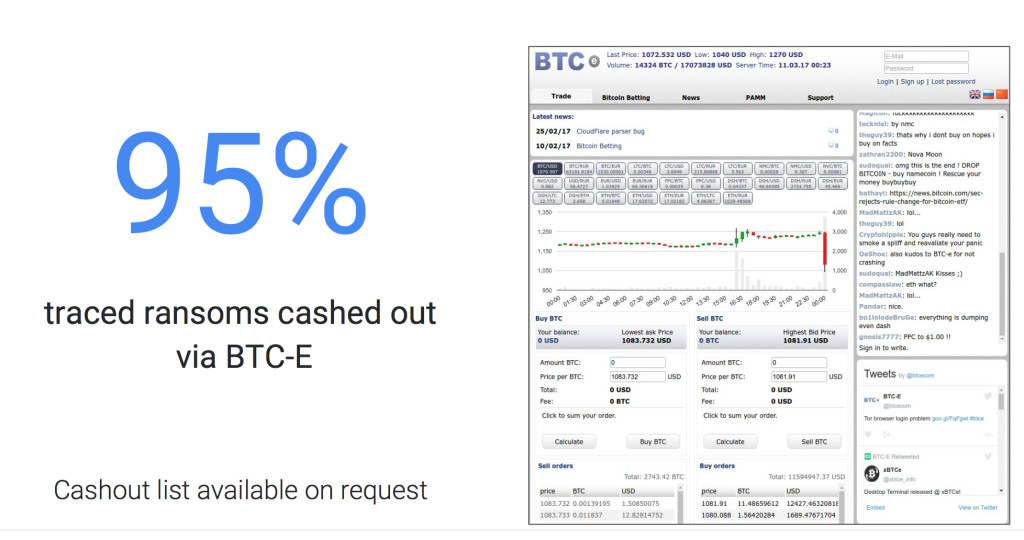
BTC-e was the Bitcoin exchange for 95% of global ransomware extortions

By Christine Duhaime | July 30th, 2017

According to tracing that was revealed this week at the Black Hat USA Conference, BTC-e was the Bitcoin exchange that serviced over 95% of all the ransomware extortion payments globally since 2014. Researchers wrote scripts that extracted payments to Bitcoin wallet addresses to determine what exchanges was used for extortion payments. The research also showed that ransomware extortion payments exceeded US$2 million per month in 2016, its most lucrative year.

The corporate entity behind the BTC-e Bitcoin exchange was indicted this week by the US as was its director, officer and founder, Alex Vinnik, who was arrested in Greece. He will be extradited to the US to face charges that include money laundering and running a MSB without the requisite AML registration and policies and procedures.

US continues its take down of Bitcoin entities with indictment of foreign Bitcoin exchange that “banked” many global cyberattackers and processed $9B in payments

By Christine Duhaime | July 28th, 2017

The US continued its take down of Bitcoin companies this week with the unsealing of an indictment against BTC-e and Alex Vinnik, and his arrest in Greece. The Indictment against Vinnik and BTC-e was obtained in January 2017, and was sealed until now so that he could be located internationally and arrangements made to effect his arrest. The Defendants are charged with operating an unlicensed MSB and 16 counts of money laundering.

According to the indictment, BTC-e operated an unlicensed MSB since 2011 that processed several billions of dollars worth of payments in digital currencies and acted as a money laundering service for cyber-criminals around the world. Vinnik is alleged to be the founder and controller of BTC-e. More particularly, BTC-e is alleged to have moved money and provided wallets (effectively to have “banked”), via Bitcoin, international bad actors who were engaged in ransomeware cybercrimes that demanded extortion payments in Biticoin.

It also allegedly banked criminals who were engaged in international drug trafficking, weapons dealing and it allegedly provided Bitcoin services to a number of corrupt public officials, although the indictment does not identify which public officials used the Bitcoin exchange. Allegedly BTC-e had no anti-money laundering controls, policies or procedures in place. Many Bitcoin exchanges provide deposit taking services for customers by virtue of the fact that they take in deposits into their bank accounts without having a bank licence and in that sense, are said to provide “banking” services, in addition to currency conversion services.

BTC-e is alleged to have accepted a significant number of transactions from the US although it advertised that it did not. It is not known where BTC-E operated as it advertised that it was in Bulgaria but was incorporated in the Seychelles and had companies in Russia, France, Singapore, BVI and New Zealand. BTC-e had 700,000 customers globally. It was Russia’s most popular digital currency exchange and over the course of its history, it received over 9 million Bitcoin worth over $18 billion. According to the indictment, BTC-e was the exchange for Liberty Reserve, which was taken down in 2013 by the US government, and many of the same people allegedly used both services.

In order to deflect law enforcement, BTC-e is alleged to have posted comfort statements on its website that were untrue, such as that it verified the identity of its customers when they were onboarded and that it did not accept funds from US persons. In essence, it is alleged that the exchange made statements about anti-money laundering compliance that were completely untrue in order to lure customers to do business with it, suggesting that it was law-abiding when the US government alleges that it was not.

Foreign digital currency exchange fined $110M in US for anti-money laundering law failures

By Christine Duhaime | July 26th, 2017

For the first time ever, the US Financial Crimes Enforcement Network (“FINCEN“), has asserted jurisdiction over a foreign digital currency exchange, BTC-E, for the purposes of fines, and assessed civil penalties for anti-money laundering law failures under the Bank Secrecy Act in the amount of $110,003,314.

In July of this year, BTC-E and its founder, Alexander Vinnik, were indicted in California for money laundering, conspiracy to commit money laundering, engaging in illegal financial transactions and for operating an unlicensed MSB. Neither Vinnik nor BTC-E were based in the US or operated in the US.

However, BTC-E conducted digital currency transactions with some persons located in the United States and moreover it used US computer servers, which according to FINCEN, was sufficient to establish jurisdiction in law for US anti-mony laundering legislation. It is unknown how many accounts BTC-E had opened in the US, if any, but its US based customers transacted in connection with over 21,000 Bitcoin and moved digital currencies within the US, and across state lines, triggering the Wire Act.

By virtue of the fact that FINCEN took the position that it had  jurisdiction under US law over BTC-E,  it fined BTC-E for violating the MSB registration requirements and the requirements to implement a competent anti-money laundering compliance program and to obtain and retain certain required records. The Bank Secrecy Act requires that a MSB register in the US within 180 days of beginning operations, and a foreign MSB accepting US transactions, must appoint an agent pursuant to corporate law to accept service.

The US government has said that one of the issues with respect to BTC-E was that it provided services to Coin.MX which was implicated in  processing Bitcoin ransomware transactions for extortion payments, whose CEO was charged in the US. BTC-E was also alleged to have provided services to other cybercriminals and to have stored and laundered the funds of extortionists connected to ransomware and to have assisted Liberty Reserve. The CEO of BTC-E, Alexander Vinnik, was personally fined $12,000,000 by FINCEN.

Mr. Vinnik was arrested in Greece and is being sought for extradited to the US in connection with the criminal charges against him for operating BTC-E. If convicted, he is facing over 50 years in jail for running a digital currency exchange incompetently and without anti-money laundering policies in place tailored to the uniqueness of digital currencies.

Biggest illegal darknet Bitcoin marketplace shut down; operated from Canada

By Christine Duhaime | July 21st, 2017

The US DoJ has taken down what it calls the world’s largest criminal marketplace on the Internet called AlphaBay yesterday, which operated for over two years on the darknet. AlphaBay was ten times larger than Silk Road, when it was taken down in 2013. AlphaBay was a Canadian darknet illegal drug marketplace with servers in Three Rivers, Quebec, Canada, that was founded and operated by a Canadian.

Like Silk Road, AlphaBay was used for trading of illegal drugs including fentanyl, to traffic in fake ID and to sell and buy guns and buy services such as hacking services and murder for hire. It accepted only digital currencies for payment – mostly Bitcoin.

AlphaBay was started by a Canadian named Alexandre Cazes, who amassed a fortune of over US$23 million in Canada and Thailand. He was arrested in Thailand on July 5, 2017, by Thai authorities on behalf of the FBI and charged with inter alia, money laundering, drug trafficking, trafficking in illegal fire arms.

He committed suicide in prison a few days after his arrest. His assets are frozen in Greece, Canada, Thailand and Antigua. The FBI has seized the digital currencies he held at various exchanges around the world. Cazes had US$3.6 million worth of Bitcoin, US$1.6 million worth of Ether and US$708,000 worth of ZCash. AlphaBay had over 240,000 different Bitcoin wallets.

Cazes applied for immigration in Antigua and Cyprus and set up bank accounts using private companies to obfuscate ownership.

AlphaBay operated on TOR and had over 200,000 users and 40,000 vendors.  At the time of its takedown, there were over 250,000 listings for illegal drugs and controlled chemicals on AlphaBay for sale, and over 100,000 listings for stolen and fraudulent identification documents and access devices, counterfeit goods, malware and other computer hacking tools, firearms and fraudulent services.

The US Attorney General said that several American teenagers died using fentanyl that had been sold through Cazes on AlphaBay.

The US DOJ has disclosed the plea deals of two people who sold drugs on AlphaBay. They were physically located from their Instagram and Facebook accounts.

With respect to AlphaBay’s owner, the following banks banked Cazes and were the subject of seizure orders: Loyal Bank in St. Vincent and Grenadines; the Bangkok Bank, the Siam Commercial Bank and the Kasikorn Bank (all in Thailand), Bank Alpinum and Bank of Ayudhya. He also had a PayPal account and several Canadian bank accounts that were still open at the time of the take down. Bitcoin Suisse AG was his Bitcoin exchange.

Cazes belonged to an offensive online forum that says it “is not open to women, homosexuals or transsexuals” where he participated in online commentary about raping women, his wealth, fast cars and the benefits of cheating.

Cazes led a lavish lifestyle, buying numerous luxurious items from cars to condos to watches despite having no gainful employment or legitimate business that he could show AML officers to justify the vast amount of funds flowing through his bank accounts.

The indictment is here.

US authorizes seizure of more assets for money laundering

By Christine Duhaime | July 20th, 2017

The US Attorney General has issued an order authorizing the forfeiture of property whenever there is conduct that is in violation of federal law more frequently than is currently being done in order to deter criminal activity. From 2007 to 2016, the DEA collected $3.2 billion from civil asset forfeiture.

Civil asset forfeiture is a practice in the US and Canada that allows law enforcement to seize cash and property suspected of being connected to criminal activity. The property owner does not have to be convicted or even charged with a crime to have his or her property seized and forfeited by the government. In the US, local law enforcement agencies can keep 80% of the assets forfeited. Law enforcement has long advocated for increased forfeiture as the only effective tool to combat transnational criminal organizations.

Predictive money laundering and damming orders – what are they?

By Christine Duhaime | July 10th, 2017

WMD

Last week, the US Treasury Department imposed sanctions against a bank in China for allegedly providing financial services to North Korean companies and said it was rolling out more sanctions in the weeks to come.

The bank, the Bank of Dandong, is alleged to have facilitated money laundering by allowing its bank to be used to move money connected indirectly with WMD. Selling, trading, financing or providing services in support of WMD is a predicate offense for money laundering and the proceeds of the offence is proceeds of crime, hence the money laundering allegation against the China Bank of Dandong which, if the allegations have merit, profited off the financial transactions and its revenues therefrom are proceeds of crime.

The bank is alleged to have provided banking services for the sale of coal, not directly for the sale of WMD. But North Korea is believed to use its proceeds from coal exports to fund its WMD program.

In May, the US DOJ had obtained what is called a “damming seizure” warrant.

A damming seizure is an unusual court order because it is granted on the basis of the predictability of criminal activity in the future and it covers the full scope of financial transactions going through a bank of the targets.

In essence, it forces banks to disclose all incoming financial transactions of the target and to block outgoing transactions, including correspondent banking transactions. The damming order was not for funds held in the US — it was for funds held offshore.

In that sense it is similar to a mareava injunction only with a wider scope and full disclosure. The constitutionality of an order based on the propensity of criminality is interesting and was litigated in the US. A damming order is anticipatory – it is not based on existing probable cause – rather it is based on cause existing at execution, namely that funds are going to be laundered at the eight banks subject to the damming order and therefore the order should be installed in advance.

The US courts held, among other things, that damming orders based on future criminality were constitutional in the US based on 2006 precedent from the US Supreme Court.

Eight banks

The damming order was served on eight US banks for funds held in the US and elsewhere but that are tied to the US by virtue of the correspondent banking relationship. The US alleges that the eight banks processed over US$700 million in financial transactions that were illegal because they were sanctions under US sanctions law.

The eight banks are:

  1. Bank of America
  2. Bank of New York Mellon
  3. Citigroup
  4. Deutsche Bank
  5. HSBC
  6. JP Morgan Chase
  7. Standard Chartered
  8. Wells Fargo

Damming orders are not new – they are usually used for transnational criminal organizations, such as the Mafia, to monitor their financial transactions between countries to learn with whom they associate and where the movement of illicit goods and money is going to and from.

Predictive AI used to guess future criminals

Interestingly, there is a debate in financial crime and artificial intelligence circles about the use of predictive AI that predicts the propensity of criminality of a person based on, inter alia, their family, business and social media connections.

In financial crime, usually a person associated with organized crime will “infect” those people around him or her, and eventually a non-criminal will engage in criminal conduct, statistically speaking. What predictive AI does is identity those persons and in some pilot cases, analysts then enter such persons in a database for monitoring by law enforcement to protect society. Theoretically, this may violate the presumption of innocence and other rights but based on case law associated with this case’s damming orders, it would appear that in the US, courts have determined that the greater interest in protecting society against the dangers of financial crime outweigh certain personal potential rights violations of persons or companies. In a round-about-way, this case could be seen as a win for the use of predictive AI by law enforcement.

Pope engages resources of Vatican to go after Mafia, corruption and money laundering

By Christine Duhaime | June 15th, 2017

The Vatican is getting into the anti-money laundering enforcement business it seems,  to save humanity and in particular, intends to go after the mafia, using the threat of excommunication to get their attention.

The Vatican convened an anti-corruption conference with, inter alia, Scotland Yard, lawyers, Italy’s national Mafia prosecutor Franco Roberti, Rome’s Mafia prosecutor Michele Prestipino, Silvano Tomasi, the former Holy See observer to the UN and the United Nations, to address methods to eradicate corruption, curb laundering the proceeds of crime and pressuring the Mafia to become law abiding.

The Pope called for the denunciation of corruption and its eradication. Referring to corruption as a “cancer“, the Pope said that organized crime and corruption are the worst scourge of our times. He noted that when a person becomes corrupt, they are decayed, they contaminate others and are worse than the plague because their crimes impact all of us. He went so far as to say the corrupt have a bad odour.

Not mincing any words, the Pope said that the evils of the world from human trafficking, trafficking of drugs, exploitation of people, slavery, unemployment, neglect of the climate and the erosion of the fundamental rights of humans is the common language of the Mafia and other transnational criminal organizations. For the world to have a future, he said, for the young to have hope, the immense crisis of corruption must be faced by the Catholic Church which must not be afraid to purify itself of criminality. He called on all to denounce the evils of corruption and join together to stop it.

Following the Conference, the Vatican said that it would engage public opinion for anti-corruption and develop laws to prevent corruption with the goal of inculcating a culture of justice.  And it is also drawing up laws for the excommunication of the Mafia from the Church.

Excommunication has been used as a form of punishment within the Catholic Church since at least the 4th century. Excommunicated Mafia are prevented from receiving sacraments, such as the Holy Communion, cannot get married in a Catholic Church and cannot receive a Catholic burial. The Pope already excommunicated the Mafia verbally in 2014 and this is seen as a more formal global excommunication that would be binding on all Catholic churches around the world.

G7 to focus on transnational criminal organizations, aviation infrastructure security, terrorist financing

By Christine Duhaime | May 27th, 2017

The G7 released a special statement on financial crime, promising to re-double its efforts from the last 12 months on ending financial crime, in particular terrorist financing and international money laundering involving transnational criminal organizations. Every year there is a commitment to these goals but this time, the G7 has promised to turn their statements “into action” and to commence working with the private sector in these initiatives.

The G7 recognized the weaknesses in security of aviation infrastructure (arising from the privatization of airports that pose an international security risk because they are operated by fund asset managers without expertise in aviation or international security), and of aviation operators and called on companies and countries to improve security in aviation.

The commitment to require the improvement of aviation safety and those who own and manage the infrastructure, is mentioned in reference to the G7 commitment to enforce the UN Convention Against Transnational Organized Crime (UNTOC) once again. The aviation industry acts, or is supposed to act, as a gatekeeper to stop transnational organized crime from using the aviation system for the movement of illegal goods and proceeds of crime. The UNTOC was implemented to deny safe haven to people who engage in transnational organized crime by prosecuting those crime where they occur, including money laundering and corruption criminal activities.

The majority of the G7 statement was in respect of a renewed commitment to also address counter terrorist financing and in addition, to require social media companies to adopt a responsible approach to publishing by stopping the publication of terrorist propaganda and material online.