The un-talked about sector in money laundering cases – the accountant

By Christine Duhaime | June 23rd, 2019

Mobster Lansky exiting a Las Vegas casino with a duffle bag of cash. Photo from Francis Miller/The LIFE Picture Collection/Getty Images

Practical and real accountants

Not much is written about the role of practical or real accountants in money laundering, or the compliance of accountants, as reporting entities to FIUs under anti-money laundering law. But it’s an increasingly interesting issue.

At least in Canada, accountants, accounting firms and their employees must report the following to the FIU, which is FINTRAC:

  • Suspicious transactions if there are reasonable grounds to suspect that a transaction or an attempted transaction in which the accountant or accounting firm is advising on is related to the commission or attempted commission of a money laundering offence or a terrorist activity financing offence;
  • Terrorist property if the accountant or accounting firm has property in his, her or its possession or control that he, she or it knows is owned or controlled by or on behalf of a terrorist or a terrorist group, as well as any information they have about a transaction or proposed transaction in respect of such property; and
  • Large cash transactions for cash transactions of $10,000 or more received in connection with a transaction in which they provided advice.

Most unreviewed sector by FIU

I believe it was according to a Freedom of Information Act request made in Canada that showed that accountants were the reporting sector with the lowest per capita number of filings with the FIU and which had the lowest number of compliance reviews conducted by the FIU. In other words, they seem to report the least when adjusted by number of firms and accountants and are reviewed by the FIU the least.

Pursuant to the design of the Recommendations of the FATF, certain sectors that touch the financial system are designated gate-keepers and accountants are one such gate-keeper. No studies have been done on the extent to which that sector complies with its gate-keeping function but anecdotally, there are countless cases in which accountants have been involved in money laundering – wittingly or unwittingly.

Cases with accountants

Lansky

According to the book “The Laundrymen”, money laundering was a business started by a practical accountant (and gangster) named Meyer Lansky, who managed the books and money for many of New York’s most well known national organized crime figures such as Bugsy Siegel and mob boss Lucky Luciano. Lansky became known as the “mob’s accountant” and “the patron saint of money launderers.” He is credited with being the person who convinced organized crime figures to move their proceeds of crime to offshore havens in Switzerland and the Bahamas to avoid detection and forfeiture. All three – Lansky, Siegel and Luciano – were intimately involved in land-based casinos, including building one of the first casinos in Las Vegas. Lansky would wash money through Las Vegas casinos for the mob.

According to an ACAMS article on Lansky, he helped the mob avoid being detected as money launderers by: (a) filing their taxes on time all the time because all money launderers file on time to avoid attention being drawn to them; (b) using offshore tax havens, preferably Switzerland; (c) avoiding lavish spending; and (d) using shell companies.

Tax havens

Probably the most famous accountant in the world, a man named Walter Diamond, now deceased, who was a bank examiner and advisor to the US government, wrote a text book of questionable content called “Tax Havens of the World”, updated annually for 25 years, in which he promoted the use of offshore tax havens to defeat law enforcement and government oversight. In his book, he extolled the virtues of offshore tax havens and wrote that they are useful to cloak bank accounts in secrecy (because of the anonymity of shareholders of private companies incorporated in offshore tax havens); to shift investments offshore without being taxed; to make sure financial dealings and financial assets remain private (to avoid taxes); and to avoid government control. His book provided an analysis of each offshore country and an assessment of the strength of each country’s anti-money laundering law enforcement – the more lax the country and the more secretive its private company structure, the more favourable a location it was, suggested Mr. Diamond. He was one of the harshest critics of the FATF because he felt that the FATF interfered with what he seemed to believe was a right to park money secretly in other countries and to own companies secretly in other jurisdictions to use to open bank accounts.

Colombia

Insight Crime reports that in Colombia, a man known only under the alias el contadorâ (the “accountant”), is believed to be a practical accountant, the chief financier and money launderer for the cartels. He is alleged to have links to the Revolutionary Armed Forces of Colombia (Fuerzas Armadas Revolucionarias de Colombia FARC) and one of the main financial backers of the Oliver Sinisterra Front of the ex-FARC Mafia and the United Guerrillas of the Pacific.

Cartels

Other international gangsters seem to like accountants to move money as well. The DEA lists another practical accountant, aka “el contador” from Mexico, who is believed to be the accountant for the Gulf Cartel and part of that cartel’s leadership, whose real name is Jose Alfredo Cardenas-Martinez. Martinez was arrested a few months ago in Mexico and is the nephew of Gulf Cartel Leader, Osiel Cardenas. As the el contador, he is believed to have been the material money mover and washer for the Gulf Cartel.

Bitcoin

Not to be left out, Bitcoin people have accountants too that have used their financial talent for inappropriate purposes. An accountant, Renwick Haddow, was indicted in the US for operating a fake Bitcoin trading platform and taking US$38 million from consumers in several countries. He subsequently pleaded guilty. Among other things, Haddow opened bank accounts for the Bitcoin exchange and acted as its authorized representative with the banks, and managed what amounted to a Ponzi scheme.

Cautionary case of wrongful investigation and arrest of accountant

But here is an interesting case from Canada that is a cautionary one for investigations and arrests of professionals for alleged money laundering.

In Canada, Jocelyn Therrien, an accountant, was investigated, arrested and charged by the police for allegedly being tied to criminality (specifically the Hells Angels) and laundering money for them. At the criminal trial, the Judge dismissed all the claims against her, before it even went to the jury, saying that there was no evidence to substantiate the charges. The accountant is now suing the police, the attorney general and the prosecutors in respect of the investigation and the charges laid against her for abuse of process and negligence. In her lawsuit, she says that the police investigation cost her all of her clients.

The case is concerning for professionals, especially accountants. Most government agencies and banks have teams of accountants and auditors who, based on this case, are at risk of criminal prosecution in the same way, or more, as Ms. Therrien was, if their organizations are unwittingly used for financial crimes. That’s because, as the Court held, Ms. Therrien had no connection to the proceeds of crime moved by the Hells Angels through the financial system and yet she was charged and prosecuted, whereas accountants do have such connections, however indirect, because financial institutions and government agencies are often unwittingly used and abused by organized crime to move proceeds of crime.

The discovery of the trial will be interesting as it will require disclosure of what forensic financial transactional evidence existed to tie the accountant’s financial transactions to the Hells Angels. If there was no tracing of financial transactions from them to her, or no evidence of financial transactions from bank records, which appears to be the case, there were then no grounds to commence the investigation, lay charges, arrest the accountant or continue the criminal trial against her. In money laundering charges, you need evidence and that evidence must be financial evidence from a qualified forensic expert, which ironically is usually a forensic accountant.

The money laundering offences are purely about moving property knowingly to obfuscate its criminal origin and therefore, the police, AG and prosecutors would have to have had evidence not only of the movement of property derived from crime through bank accounts between the Hells Angels and the accountant, but also evidence that even if the accountant moved property derived from crime, she did it knowingly. The DPP in Canada has testified to Parliament on the high standard of evidence and proof required to bring a money laundering charge in Canada. That’s why, they have testified in Parliament, there are so few charges and prosecutions in Canada. Since the time of the prosecution of Al Capone in 1931, the standard to lay a charge has been evidence of financial transactions establishing the requisite crime from qualified forensic accountants.

Vancouver has a famous case, never prosecuted, where over $500,000 in Bitcoin was paid to the Hells Angels to murder people, which is traceable on the Blockchain (read here), and the province of Quebec housed the world’s largest money laundering operation tied closely to Russian organized crime (read here), also never prosecuted in Canada, which is also traceable on the Blockchain – so why the case against the accountant was pursued vigorously or at all, is unknown when more solid cases are on the shelf.

One more important aspect to keep in mind is that Courts have ruled that money laundering reports produced by bank or other AML consultants are not a protected communication and are compellable. This applies irrespective of if the bank or other entity made a filing with a FIU. So in a litigation involving wrongful filing of police reports or of other information that leads to a wrongful investigation and an arrest of a professional, the litigant can compel AML-related documents from banks and other parties to litigate or to defend wrongful charges, and the banks and other entities are not entitled to redact such reports.

If you want to learn more about accountants, the FATF has guidance in respect of the role and obligations of accountants here, which is an interesting read of the expectations of accountants in anti-money laundering law.

The Canadian: “[D]ude, we’re criminal drug dealers – what line shouldn’t we cross?” Explaining the Silk Road Money Laundering Case

By Christine Duhaime | June 10th, 2019

4th Anniversary of Silk Road founder’s Sentencing

The end of May marked the 4th Anniversary of the sentencing of Ross Ulbricht, aka Dread Pirate Roberts, the founder of the now-defunct darknet marketplace website based in California, called Silk Road that operated on TOR, which brokered sales of illegal goods and services, including narcotics like heroin, weapons, murders, and fake ID, payable only in Bitcoin. The criminal complaint is here.

Ulbricht was convicted by a jury of seven crimes – narcotics trafficking which carries a sentence of 10-years to life; distribution of narcotics online which carries a sentence of 10-years to life; conspiracy to trafficking narcotics which carries a sentence of 10-years to life; running and continuing a criminal enterprise (organized crime) which carries a 20-year sentence to life imprisonment; conspiracy to aid hacking which carries a sentence of 5 years; trafficking in fraudulent ID products which carries a sentence of 15 years; and money laundering which carries a sentence of up to 20 years. On minimum sentencing, he was facing life imprisonment if given consecutively.

The fact that he was charged with what is called the “super kingpin” law (e.g., operating a continuing criminal enterprise) meant that prosecutors were going for a term of incarceration of life without possibility of parole from the outset. The super kingpin law includes the death penalty in cases where the kingpin has commanded, induced or procured the murder of another person.

On May 29, 2015, the Court vacated two of the convictions sua sponte and sentenced Ulbricht for the remaining 5 convictions to two life terms of imprisonment plus forty years at a federal prison in the US, with no possibility of parole. At sentencing, the Court ruled that in the unlikely event he was ever released, he must be supervised 24/7 for the remainder of his life and be prohibited from access to a computer because the Court determined that “he cannot be ever trusted to comply with the law in his lifetime”.

Ulbricht ran Silk Road with the help of a Canadian who was his right hand man and CEO of Silk Road (more on that below). Together, it appears, there was no line they would not cross in financial crime and otherwise, including allowing the sale of cyanide on Silk Road that they appear to have acknowledged could kill people.

Novel Case

The case was novel for many reasons including:

  • Ulbricht was the first prosecution of a founder of a darknet illegal goods and services marketplace;
  • it was one of the largest money laundering prosecutions;
  • it was one of the first prosecutions involving the introduction of evidence of the tracing of Bitcoin transactions;
  • it was the first (and probably the last) instance of a defence strategy that argued that the brokering of illegal drugs online was socially beneficial to society;
  • it appears to have been the first TOR money laundering case; and
  • it resulted in online hate, defamation and death threats on Twitter against the Judge presiding over the case, including incitements that she should be killed on the steps of the Courthouse, which caused the US Department of Justice to commence a criminal investigation and obtain a grand jury subpoena for the identity of the persons who incited violence against her.

Ulbricht’s Defence

Followers of the Ross Ulbricht case are divided on whether his sentence was just or whether it was punitive.

Some believe his defence strategy was a gamble, and that he played poker with his life with his eyes wide open and lost. That’s because he was offered a plea deal of ten years to life and gambled and said no and also because his defence was, inter alia, that although he created Silk Road, he handed it off to someone else and was not its administrator or controller, and was framed for the crimes he was charged with by the unknown perpetrators of those crimes. Ulbricht also tried to divert investigators and blame others for the commission of his crimes.

Ulbricht resiled from the position of claiming not to have been the creator and administrator of Silk Road after he was convicted.

With respect to the tens of millions of dollars in Bitcoin in his possession, his defence was that it was capital gains from trading Bitcoin which he alleged did not originate from running Silk Road. With respect to the billions of dollars generated from the site, we do not know where it all ended up. He also made an argument at sentencing that was likely harmful to his case, that the activities underlying his convictions (e.g., his drug trafficking, organized crime and money laundering) were socially responsible activities and positive for society.

His defence was impacted somewhat by the fact that the Court ruled to protect the identity of some people testifying against him until just before the trial to protect them from intimidation, threats or attempted murder orchestrated by Ulbricht. The Judge had anticipated the risk of physical harm from people in the Bitcoin ecosystem and indeed, this was before threats to kill her were made on Twitter by anonymous persons.

Some Bitcoin people have publicly said, and relentlessly tweeted, that they believe he should be set free because in their view, money laundering, serious drug trafficking, selling fake IDs for the commission of crimes, and organized criminal activities, are not serious criminal offences worthy of incarceration and that such crimes cause no harm to society.

Q – Are there any connections between Silk Road and Ross Ulbricht to Canada?

A – Yes, there are numerous connections to Canada in the Silk Road story.

(i) Bought Fake ID from Canada

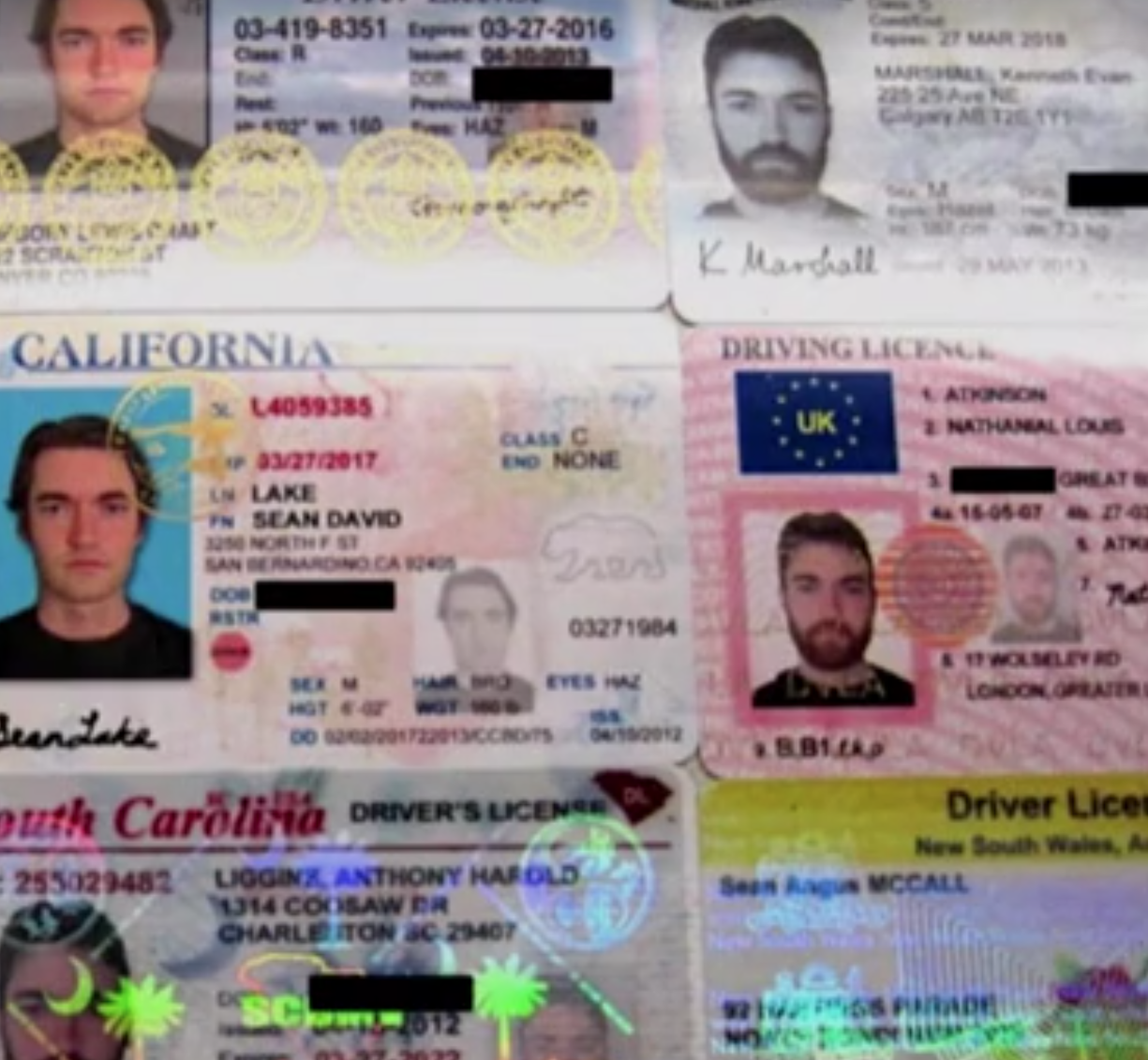
First, in the summer of 2013, Ulbricht ordered almost a dozen pieces of falsified government identity products (US state driver’s licences) for himself from Vancouver, Canada, using a vendor on his own website and paid for them in Bitcoin. Those falsified IDs were intercepted by the US Postal Service. That interception informed HSI as to his address because he had the package shipped to his apartment in San Francisco. This was several months before Ulbricht’s arrest. HSI said later that they did what is called a controlled intervention with Ulbricht, to ask him questions about the fake ID from Canada. That package was part of several incidents that led to law enforcement putting the pieces together among various federal agencies to ultimately confirm his identity and locate him.

Fake ID ordered with Bitcoin from Vancouver.

(ii) Hired Murderers in Vancouver

Second, in 2013, Ulbricht commissioned online several murders  – one of a person living in White Rock, British Columbia, from the Hell’s Angels in Vancouver which he paid for in Bitcoin and which was recorded on the Blockchain. While his chats on TOR and Blockchain tracing prove the commissioning of the acts of the murders-for-hire, there was never evidence of a homicide in White Rock, British Columbia that police could tie to this case, or at least no body ever located. So in other words, while he ordered the murders and the payments were made in Bitcoin to Vancouver and are on the Blockchain, no actual bodies have been located and it is likely that he was played all along in respect of the murders, meaning that the person he wanted killed and the alleged killer were one and the same person and merely played him for US$650,000 in Bitcoin.

Regardless, it is a serious criminal offence to plot the murder of someone and separate offences to pay the Hell’s Angels to perform such crimes.

The FBI deposed that Ulbricht paid for five other murders in Bitcoin.

After hiring to have a person murdered in Vancouver, Ulbricht wrote in a chat on Silk Road: “I’m pissed I had to kill him. . . . I wish more people had integrity”, in which he meant that he, the contractor for a killing, was the person with integrity and the victim was not.

(iii) More Canadians Per Capita Bought Illegal Stuff on Silk Road the Most

Third, over 6% of the Silk Road TOR site was used by Canadians, meaning that over 6% of the criminal element involved Canadian sellers who had accounts at digital currency exchanges and used it to sell illegal goods and services on Silk Road and correspondingly, over 6% of the buyers of illegal goods and services on Silk Road were Canadians, who also used digital currency exchanges holding Bitcoin to make their buys and have narcotics, weapons and such shipped to them in Canada. Canadians ranked 4th among number of users of Silk Road, which is a phenomenally high number considering the small population of Canada.

(iv) Most Prolific Drug Seller Allegedly in Vancouver

Fourth, one of the most prolific sellers of illegal drugs on Silk Road was allegedly a Canadian in Vancouver named James Ellingson, who allegedly sold over $2 million worth of cocaine, heroin and other illegal drugs online. The US has sought his extradition to face prosecution in the US for allegedly trafficking illegal drugs online through Silk Road.

(v) Silk Road CEO was Canadian

Fifth, according to US prosecutors, Ulbricht’s mentor and chief advisor was a Canadian named Roger Thomas Clark, who advised Ulbricht on all aspects of the operations of Silk Road, and how to avoid detection of US law enforcement. Clark was aka Variety Jones and figured prominently in the Silk Road chat evidence in the Ulbricht trial.

According to this investigative reporter, Clark was appointed CEO of Silk Road by Ulbricht.

In those chats, Variety Jones and Ulbricht mentioned using violence to keep people from cooperating with law enforcement and Clark wrote: “[D]ude, we’re criminal drug dealers – what line shouldn’t we cross?”

The two were aware that their activities triggered the super kingpin laws. On one occasion, Clark wrote to Ulbricht: “Not to be a downer [but] …understand that what we are doing falls under Drug Kingpin laws, which provides a maximum penalty of death upon conviction. . . . The mandatory minimum is life.”

Not to be deterred with the prospect of life in prison, Ulbricht replied: “All in, my friend.”

In 2015, Clark was arrested in Thailand and eventually extradited to the US. He fought extradition for 2 1/2 years and lost. He is incarcerated in the US and faces money laundering, trafficking in falsified ID, and narcotics trafficking charges in the US.

Q – What has Ulbricht said about Silk Road and his role in its creation and operation?

A – For his sentencing, Ulbricht submitted that he did create Silk Road and admitted he was its administrator and said he did it because he was a young idealist who wanted people to have the freedom to pursue their own happiness.

Q- Was he a money launderer?

A – Yes, he was convicted of conspiracy to launder money with an underlying narcotics offence and specifically, of trafficking 60,720 kilos of illegal narcotics.

Q – Why did Ulbricht get two life sentences plus 40 years and is that normal?

A – Ulbricht’s sentence was partly for deterrence. The Court noted specifically that what Ulbricht did was unprecedented in terms of the operation of a vast criminal enterprise and for anyone thinking about copying Ross Ulbricht, they needed to understand, without equivocation, that if they break the law like he did, there will be “very, very severe consequences.”

It is not unprecedented in the US for defendants who are charged as super kingpins of narcotics trafficking organizations to receive a life sentence.

According to the United States Sentencing Commission, in 2013, the relevant year for Ulbricht’s sentencing, 153 offenders in the US received terms of life imprisonment from federal judges and another 168 received terms that were so long, it was akin to a life sentence because it surpassed a life sentence. The most common type of conviction to receive a life sentence was for drug trafficking, similar to Ulbricht. Ulbricht is among 4,500 inmates in the US who are serving life sentences.

The drug trafficking guidelines, which are applicable to Ulbricht, provide for a sentence of life imprisonment for drug trafficking offences where death or serious injury resulted from the use of the drug and the defendant was previously convicted of a drug trafficking offence. In some cases, however, if there is a very large quantity of drugs trafficked, the sentencing range can include life imprisonment.

In Ulbricht’s case, the fact that he was convicted of continuing a criminal enterprise and the Court found that his enterprise sold illegal narcotics to underage teenagers, meant that under the sentencing guidelines, the severity of the punishment was increased.

Followers of Ross Ulbricht have called for his sentence to be reduced. The Judge found that given the gravity of the offences, it was not possible for him to be rehabilitated into a law abiding person.

Q – Wasn’t Silk Road just like an Amazon, so what was the harm?

A – At one point post trial, Ulbricht did raise this argument, arguing that he was like a landlord who let his tenants sell drugs. His lawyer argued at sentencing that his conduct was equivalent to the owner of a crackhouse and that he should be held criminally liable, at most, for the use of his premises for criminal purposes with his knowledge, taking into account that the premises were a website.

The prosecutor countered that with evidence that Ulbricht had himself said in his own words that he was “lead[ing] an international narcotics organization” and that the drug dealers selling on Silk Road were his “business partners.” The prosecutor noted that like all heads of a TCO, the defendant did not sell drugs himself because he did not have to; he had an entire online network of persons under his umbrella who did the selling, and like any drug kingpin, he earned commission from every sale in Bitcoin.

Q – Is it true Ulbricht allowed cyanide to be listed on Silk Road for sale after acknowledging he knew it would be used to kill people?

A – Yes.

Q – Did Ulbricht believe that what he was doing was criminal and against the law?

A – Yes, he said so in his TOR chats, and was aware that the risk was life imprisonment if ever caught, prosecuted and found guilty. At sentencing, though, he expressed remorse for having set up Silk Road and said that he threw away his life doing it.

Q – Can Ulbricht appeal his case?

A – He has exhausted all appeals and was unsuccessful on all his appeals.

Q – Is it true teenagers died as a result of Silk Road?

A – Yes, the prosecution at trial introduced evidence of six drug overdose deaths tied to Silk Road, and two of those were teenagers. Ulbricht argued that some teenagers had previous health issues and even if they died of drugs acquired from him, he was not responsible for those deaths because of their pre-existing medical conditions.

Under tort law, though, a drug dealer takes his customers as he finds them and is responsible for drug-related deaths his drugs caused irrespective of the health of the user.

Ulbricht did not dispute the evidence that teenagers and others had purchased illegal drugs from Silk Road and that those purchases contributed to their deaths.

One of the teenagers who died from drugs sold on Silk Road

Q – What was the defence Ulbricht instructed his lawyer to argue that Silk Road was a responsible enterprise?

A – The defence was instructed to argue, inter alia, that he “did not create the world” and his sentence should not be enhanced just to stem the evolution of sales of illegal drugs on the darknet, because a sentence of deterrence would not curb illegal drug sales using TOR sites and such a sentence would be akin to trying to stop the world from spinning.

The defence at sentencing also submitted that Silk Road was an example of responsible drug dealing because it had harm reduction protocols in place and, they submitted, Silk Road’s drug sales had a positive and progressive element, making drug sales safer for everyone.

The Judge called these arguments fantasy, noting that “no drug dealer from the Bronx selling meth or heroin or crack has ever made these kinds of arguments to the Court”, and noting that it was an argument from a person with a privileged life. The Judge noted that Ulbricht made illegal drugs available over the Internet to communities around the world that previously had no access to such drugs and rather than making the world safer with his drug activities, he expanded the availability of narcotics globally and made it a more dangerous place for teenagers and everyone else.

A timeline (hard to follow) is here.

Brazil arrests 2 bank employees for AML compliance failures that allowed $249 million to be laundered

By Christine Duhaime | June 2nd, 2019

Two bank employees arrested over AML failures

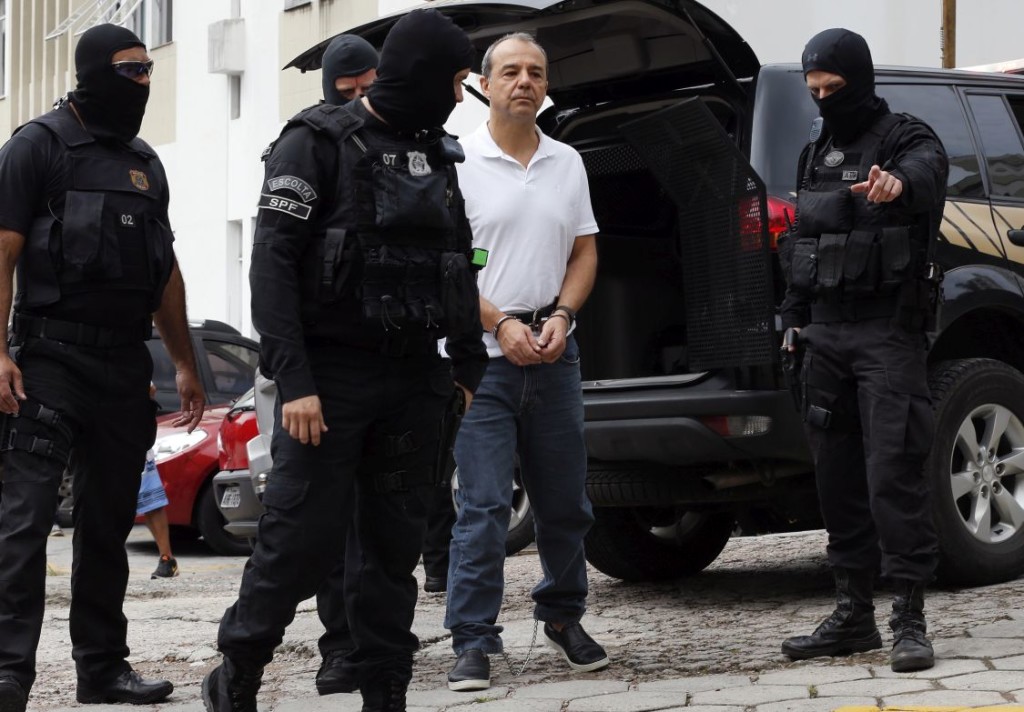
Brazil’s chief prosecutor, Eduardo El Hage, who is in charge of Operation Car Wash, obtained an order from Brazil’s federal court for the arrest of two bank employees with Banco Bradesco SA this week, arguing that they were lax on applying anti-money laundering law. Their alleged AML compliance failures, the prosecutor says, contributed to a vast money laundering scheme where proceeds of corruption flowed through the banks and the financial system.

The two employees are described as co-conspirators who helped former governor of the state of Rio launder the proceeds of corruption through that bank. Cabral is serving a jail sentence of 100 years for money laundering and state corruption.

Ex-governor was paid $249 million from infrastructure firms

Ex-governor, Sergio Cabral, serving a 100 year jail sentence for financial crime, on his way to Federal Court in Brazil.

Cabral’s bribes were for large infrastructure projects and were from asset managers and construction companies who paid for infrastructure deals while he was governor. Cabral was a politically exposed person (PEP) at the bank, which meant in additional to all the other AML requirements, he was to be flagged for high risk for money laundering.

Cabral fit the typology of many AML red flags – his lifestyle far exceeded his salary – for example, despite earning less than $100,000 per year, he had an 80-foot luxury yacht, six fast luxury cars, six expensive watches from Cartier, Bulgari and Tag Heuer, a beach-front mansion, five upscale apartments and a jet ski.

By turning a blind eye to shell companies and financial crime, the bank employees are alleged to have helped him launder $249 million. One such payment was from a billionaire in Brazil, Eike Batista, also a PEP, who gave Cabral a $16 million bribe. Batista was given a 30 year sentence for bribery.

Brazil may sue bank for society’s losses from AML failures

Earlier in the week, the prosecutor said he was considering launching a separate lawsuit against the bank for damages, over its AML compliance failures generally because it did not prevent money laundering, and he said that he believes that banks should have detected money laundering from the proceeds of corruption in Cabral’s case.

This may be the first case where a bank is sued by a government over AML failures that harmed society.

TD Bank sued over $7 million in diamonds stolen during a bank heist from a safety deposit box

By Christine Duhaime | June 1st, 2019

While not a new case, this litigation is interesting for the fact that it discusses the practice of safety deposit box swaps to transfer assets anonymously, and the holding that there is no requirement that safety deposit boxes contain lawfully obtained property. IOW, under the common law, a safety deposit box can contain stolen items and proceeds of crime.

The litigation involves an action by the family of a woman who stashed $7 million in diamonds in a safety deposit box at the TD Bank in New York City that was looted during a bank heist, to recover the value of the loss property.

The facts are that on August 2015, a company named BAT LLC sued TD Bank, alleging breach of contract and negligence over $7 million worth of diamonds that disappeared.

The diamonds were owned by Abraham Sieger, who assigned them to BAT, which entered into a safety deposit box contract with TD Bank. After the contract was entered into, the diamonds were placed in the safety deposit box for safekeeping.

In August 2012, TD Bank suffered a bank heist. Robbers drilled a hole in the ceiling of the bank vault at TD Bank, crawled through the hole, and opened many of the safety deposit boxes, including the box rented by BAT. The robbers were never identified or located, and the TD Bank did not recover any of the assets stolen during the heist.

The diamonds were initially bought in 2008 by Helen Sieger. Ms. Sieger was indicted and arrested in New York on theft charges for unrelated business activities. She jumped bail and moved to Miami and lived under a fake name. While in Miami, she allegedly instructed a Mr. Greisman to open a safety deposit box at the TD Bank and to take possession of the contents of an existing safety deposit box at the same branch. He was to take possession of the unknown contents of the safety deposit box from an unidentified woman.

Allegedly, Mr. Greisman asked his daughter, and her husband, to open the safety deposit box at TD Bank, which they did. Ms. Sieger then asked him to show up at the bank on June 15, 2010 and do a box-swap with the unidentified woman. The box-swap involved asking TD Bank for both parties to access the vault at the same time; asking TD Bank to use its key to open both boxes at the same time; and once TD Bank staff left, the parties swapped the contents of one box for the contents of the other, meaning they placed the wrong box behind the wrong safety deposit box number. No one opened the safety deposit boxes themselves.

Ms. Sieger was later arrested in Miami for unrelated matters, returned to New York, where she died at Rikers Island.

In June 2011, Mr. Greisman and his children, met their lawyer at the TD Bank with a gem appraiser and opened the safety deposit box. The gem appraiser appraised the diamonds in the safety deposit box at $7 million.

A year later, the bank heist occurred and the diamonds disappeared. The plaintiffs sued for the value of the diamonds. TD Bank argued, inter alia, that they were not liable because the contract was fraudulently entered into and the box was used to hold diamonds that were unlawfully obtained and held to defeat claims by authorities. The Court held that there is no implied covenant that a safety deposit box contain lawfully obtained items and, not surprising, no obligation of a customer to disclose the contents of a safety deposit box to a bank. The TD Bank has no knowledge of whether or not the diamonds were unlawfully obtained. Only Mrs. Sieger, now deceased, knew how she came to own $7 million in diamonds, and whether they were a gift, a trade, purchased or borrowed.

The litigation is still ongoing.

Study in China identifies areas in China where most money launderers originate and finds that the number of suspicious activity reports filed does not improve effectiveness

By Christine Duhaime | May 31st, 2019

According to money laundering law empirical research from China, a person from Fujian (the well-known Triad land) is most likely to be a money launderer, and the study also found that the filing of voluminous numbers of suspicious activity reports (SAR), does not lead to improved anti-money laundering results across any sector or in the economy.

Filing SARs

Researchers looked at millions of reports and found, after comparing six years worth of data, that China submits 187 times more SARs than the UK and 32 times more than the US, but that when it came to money laundering prosecutions, the UK had 5 times more prosecutions from SARs than China, and ten times that of the US.

The reason for the lack of a correlation to the filing of SARs and prosecutorial results in China, as compared to the UK or the US, was based on the fact that China, unlike the US and UK, has a prescriptive or rules-based reporting regime.

A rules-based reporting regime requires reporting irrespective of identified risks. In contrast, risk-based reporting regimes require reporting based on a risk assessment.

Canada has a semi-hybrid model where a risk assessment is required to assess risks of the incidents of the occurrence of a money laundering or terrorist financing risk occurring and steps to mitigate such risks, but a reporting regime unconnected to a risk assessment that like China, is 100% rules based.

An example of an AML law regime that is risk based would be, for example, laws that accommodate financial inclusion and require obtaining and verifying the identity of an account holder on the basis of the risk they pose consistent with the FATF Recommendations. In contrast, a rules based regime in AML law requires treating every account holder exactly the same, irrespective of the risks they pose to the financial system. That’s what Canada has.

Predicate offences most often committed in China 

The researchers then looked at 221 money laundering cases in China and made some conclusions about risks of financial transactions in China based on geography, and that exit out to other countries, including Canada.

China has far fewer predicate offences under the federal Criminal Law of China than Canada or the US, and thus with respect to underlying predicate offences to a money laundering offence, no comparisons could be determined.

The predicate offences most likely to occur in China were corruption involving government officials (42%), drugs (8%), smuggling (8%) and tax evasion (5.8%).

Geographical areas most high risk for money launderers in China

The researcher’ geographical risk assessment of China concluded that the risks for money laundering were higher in coastal provinces and were correlated to higher levels of economic development and foreign trade. In terms of pure domestic high risk areas, researchers found that the areas most at high risk for money laundering were Fujian, Zhejiang, Guangdong, Jiangsu, Shandong and Chongqing.

When it comes to provinces with international exposure in China, the high risk areas for money laundering activities were:

  • Guizhou
  • Gansu
  • Hainan
  • Tibet
  • Yunnan
  • Sichuan
  • Guangxi

The provinces with the lowest propensity for money laundering activities were:

  • Tianjin
  • Liaoning
  • Shanghai
  • Jiangsu
  • Guangdong

Fuzhou, home of the Triads and most money launderers

Fujian scored high as an area for money laundering likely because Fuzhou, its main city, is the birthplace and epi-centre of the Triads, one of the world’s oldest and most dangerous organized crime gangs. The Triads date back to the first of the seven dynasties. In China, the Triads are considered to be a black society, or a black group – in Mandarin, “hei shehui”.

Black societies have a small group of administrative leaders insulated from political and police pressures by a large number of soldiers who have an extensive infiltration into all levels of police and political organs, which allows them to operate without risk of arrest and/or investigation. Immigrants to Canada that are accepted through the Quebec investor immigration program have been known to be most often from Fuzhou and Xiamen – two Triad cities in Fujian with high rankings for financial crime.

Triads grew and grow their organizational power no matter where they are – Fujian, Hong Kong or Canada – from gambling, forced sexual trafficking of women, and extortion (pictures of Triads here in which they are chilling with proceeds of crime).

PEPs most at risk for being money launderers in China

With respect to risks arising from type of customer, the researchers found that politically exposed persons pose the greatest statistical risk of being money launderers in China. Second was persons in financial services (banks or securities brokers) because they have access and ability to defraud banks and crucially, to exit proceeds of corruption out of China.

“Escaped to Vancouver”

Researchers noted the fact that the Bank of China was defrauded by many of its politically exposed executives who exited RMB 3 billion and escaped to Vancouver with the proceeds of crime.

The third most high risk occupation to be a money launderer in China was people who set up private companies and who transfer, using companies that are often fake, vast amounts of proceeds of crime out of China to foreign countries. Since the study found that such funds are attached to persons who “escaped to Vancouver”, it may be reasonably inferred that it is private companies in British Columbia that are used more than in any other jurisdiction.

Researchers looked at the use of underground services (sometimes incorrectly referred to as underground banks) to exit money illegally from China to other countries and found that more than 50% of those cases involved government officials who had proceeds of corruption they exited out without detection.

The publication of secretly taped political corruption video of Austrian vice chancellor violates the law and may be criminal, says German data privacy chief

By Christine Duhaime | May 26th, 2019

Privacy violation vs public interest

One of Germany’s heads of data protection and privacy agencies says the publication by newspapers of the secretly-filmed video of Austrian politician Heinz-Christian Strache discussing potential bribes for contracts while on vacation, violates privacy law and may be criminal, as well as harmful to political culture.  The video, filmed in a house  rented by Strache in Ibiza in 2017 while he was on vacation, contains footage of Strache discussing offering government contracts in exchange for political support in the media. The discussion was with a Russian woman who posed as a fake foreign investor, allegedly looking to invest in Austria.

At that time, Strache was one of the leaders of the political party called the Freedom Party (“FPÖ“).

In the video, he is told that the Russian woman negotiated to buy a newspaper called Kronen Zeitung and that she would use the newspaper to promote the FPÖ during the elections. Strache was not aware he was being recorded. When the secret video was leaked two years later, he resigned as vice chancellor of Austria. Austrian Chancellor Sebastian Kurz, also of the FPÖ, called an election after Strache resigned. Kronen Zeitung stated that is had never held discussions to sell the newspaper and that the story was made up.

US Treasury designates what may be first Canadian company as part of a significant money laundering organization and drug trafficking organization

By Christine Duhaime | May 24th, 2019

Canada now has its first official drug kingpin and its a company in Ontario.

The US Department of the Treasury’s Office of Foreign Assets Control yesterday designated a Canadian company as part of a significant foreign money laundering organization and drug trafficking organization.

The Kingpin Act is used for the most serious of designations and includes the most powerful TCOs in the world, the ‘Ndrangheta, as well as the most powerful Mexican cartel, the CJNG, as well as the Sinaloa Cartel and Los Zetas. Both El Mencho and El Chapo are designated drug kingpins.

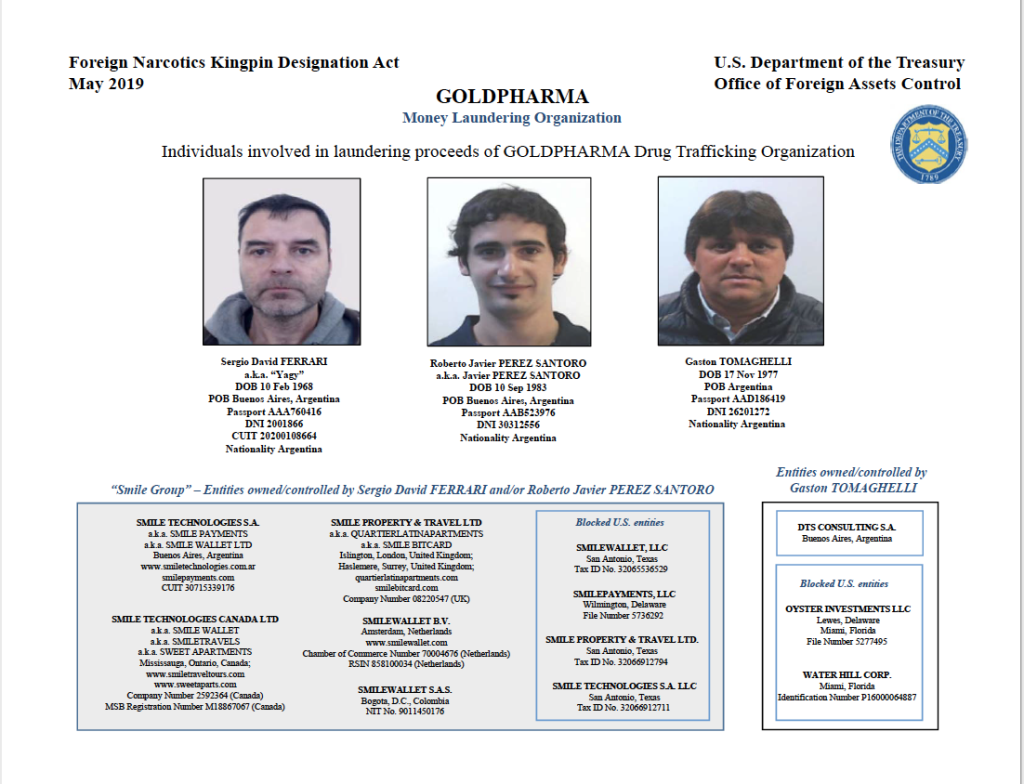
The Canadian company which joins their ranks, Smile Technologies Canada Ltd., is registered in Ontario. This is believed to be the first time the US has designated a Canadian company as part of a network of a significant money laundering organization and a significant drug trafficking organization pursuant to the Foreign Narcotics Kingpin Designation Act.

The Canadian company is part of a designation of a network of individuals and companies identified by OFAC as the Goldpharma Drug Trafficking Organization and Money Laundering Organization. The network, originating in Argentina, is alleged to have sold narcotics and opioids such as oxycodone and hydrocodone online to users in the US and Canada through websites, and to have helped fuel the opioid crisis in Canada and in the US.

According to OFAC, Smile Technologies Canada Ltd. funneled the proceeds of crime from illegal narcotics trafficking from Canada back to Argentina.

Smile Technologies Ltd. was registered with Canada’s FIU, FINTRAC, as a money services business. The US Treasury has said that the network, including the Canadian entity, demonstrates the sophisticated tactics money launderers use.

It has three offices in Mississauga and three websites operating from Ontario. Its not clear why it was registered as a money services business with FINTRAC and whether it actually operated as a money services business in Canada. It also appears to have operated a payments FinTech of some type and to have been in the crypto space, issuing Bitcoin cards which are reloadable anonymous pre-paid access cards loaded with a certain amount of Bitcoin.

Eight individuals were designated as part of the Goldpharma MLO and DTO, as well as eight other companies. The two individuals designated for money laundering and tied to Ontario-based Smile Technologies Canada Ltd. are Sergio David Ferrari and Roberto Javier Perez Santoro. Five of their partners in the Goldpharma network were indicted in the US in 2018 for narcotics trafficking.

In making its announcement, OFAC noted for one of the first times, that the penalties (for banks, accountants, trustees and such) to not freeze the assets of the sanctioned persons and entities carry civil penalties of up to US$1.4 million per violation, criminal penalties of up to US$10 million and terms of incarceration of up to 30 years.

Pursuant to sanctions law, all property and interests in property of the designated persons in the US or in the possession or control of US persons must be frozen and reported to OFAC. Designations by OFAC under the Kingpin Act are intended to deny significant international narcotics traffickers access to the financial system.

A significant amount of work by US law enforcement agents would have gone into what we call unpeeling the layers of corporate beneficial ownership in many countries to uncover the network’s players and pursuant to the OFAC notice, the information in respect of the Canadian entity’s controllers is not confirmed. The reason for this is that in Canada, beneficial ownership law is complex. Among other things, information in respect of beneficial ownership of private companies is obtainable only if the articles of the company permit the disclosure of such information.

In the past, another Canadian company based in Vancouver, PacNet, was listed by OFAC as a “significant transnational criminal organization” under different legislation, namely Executive Order 13581 which deals with unusual and extraordinary threats to national security, foreign policy or the economy of the US under the authority of the International Emergency Economic Powers Act and the National Emergencies Act.

And before that, another Canadian company, the Lebanese Canadian Bank was listed by OFAC as a primary money laundering concern under the Patriot Act because it facilitated the laundering of money from drug trafficking and trade-based money laundering. The Bank had an office in Montreal and maintained extensive correspondent accounts with banks worldwide.

Several agencies take down Bitcoin mixing & anonymizing service

By Christine Duhaime | May 24th, 2019

Working with Europol, several law enforcement agencies shut down a Bitcoin mixing and anonymizing service called Bestmixer, which was one of the largest mixing services for digital currencies.
Mixing and anonymizing services or anonymizing exchanges process digital currencies on behalf of customers in order to make it difficult to trace the digital currencies.

The purpose of preventing tracing is to defeat the administration of justice and the rule of law by preventing the tracing of financial transactions so that neither law enforcement agencies nor civil private parties can pursue justice, regardless of the purposes – whether it be for taxes, to pursue investigations for theft, fraud, divorce or to recover assets. Mixing is also called tumbling or Bitcoin laundering. Canada had, and may still have, two of the largest tumbling services in the world — one based in Toronto and another allegedly based on the west coast.

In exchange for mixing digital currencies, the services take a commission ranging from 1% to 5% of the value of the digital currencies being mixed. Mixers funnel digital currencies through hundreds of wallets and split them up so that tracing is difficult and time consuming.

Many darknet marketplaces that sell illegal drugs, weapons, fake ID, child pornography and murders-for-hire services payable with Bitcoin have mixers built into the service in order to make it hard for law enforcement to obtain the transactors behind the transactions.

Law enforcement conducing the investigation of Bestmixer said that many of the users of this particular service had a criminal origin or criminal destination and the mixer was used to launder proceeds of crime.

Mixers and tumblers are not actually anonymous because the service has all the data from every customer, on what wallet address was the entry point and to what wallet address or addresses, it exited to, as well as IP addresses. For example, we did a digital currency tracing in support of a law enforcement file of several digital currencies that used an anonymizing service. Law enforcement believed the wallet holder was involved in organized crime. The anonymizing service, on request and as part of the financial crime investigation we were assisting with, was able to provide the data on the exit addresses the digital currencies exited to after being tumbled through the anonymizing service. From that exit point, we were able to trace the digital currencies to a digital currency exchange.

Legality of Mixers?

There is a lack of clarity on whether mixers, tumblers and anonymizing services are illegal but in most countries, financial transactions designed to defeat the rule of law, to obstruct justice or to defeat the fulfilment of a civil claim, is illegal. If mixing or tumbling digital currencies defeats or inhibits private investigators working for civil asset recovery or law enforcement from tracing financial transactions, arguably it is not legal. No Court has yet ruled on the issue but arguably, using a mixer, tumbler or anonymizing service could be a fraudulent conveyance where the purpose is to avoid liability civilly or criminally.

As a matter of equity, as well, such services, where they defeat the discovery or recovery of assets, could be forced to de-anonymize in civil litigation matters. That’s because it is the province of equity to supply the defects of the common law and it is also the province of equity to mitigate the rigours of the common law, irrespective of the fusion of law and equity.

Mixers, tumblers and anonymizing services that purport to claim their services are not designed to defeat the rule of law may be estopped from arguing a different set of facts to avoid de-anonymizing transactions as part of an investigation.

OFAC designates a judge and former state governor as Mexican cartel drug kingpins

By Christine Duhaime | May 21st, 2019

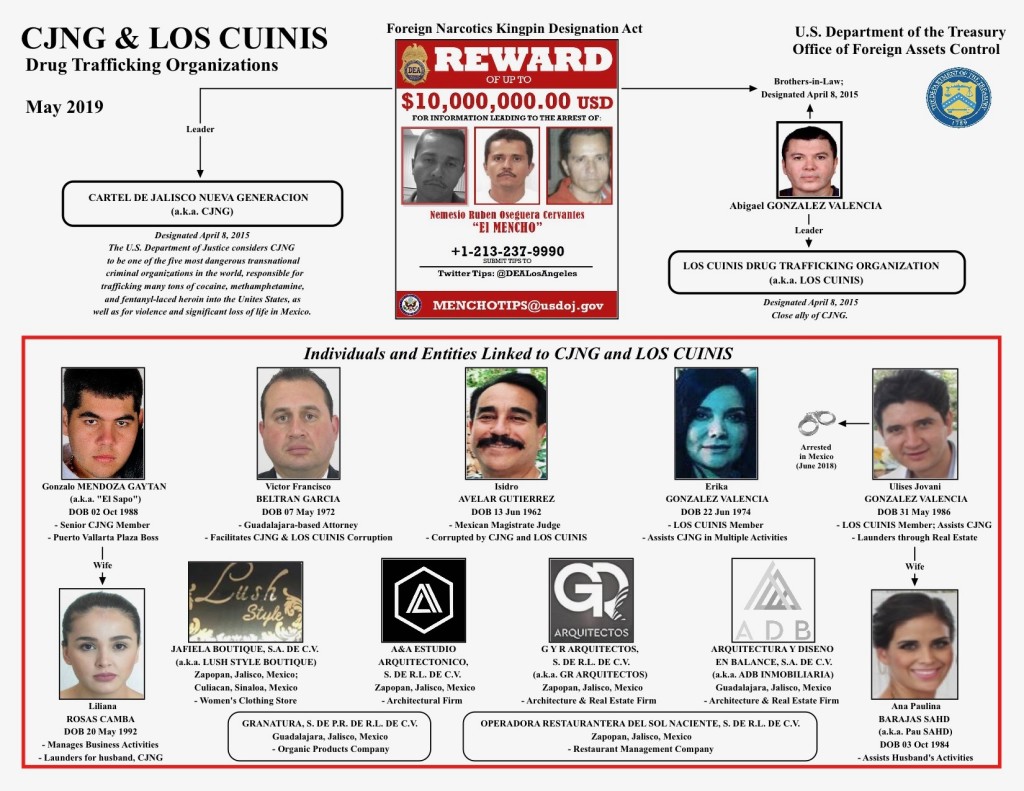
Last week, the U.S. Department of the Treasury’s Office of Foreign Assets Control (“OFAC“) designated several people associated with the most powerful drug cartel in Mexico, the Cartel Jalisco Nueva Generacion (meaning the new generation cartel of Jalisco), as drug kingpins.

Added to the drug kingpin sanctions list is a Mexican Judge, Isidro Avelar Gutierrez, who is believed to have accepted bribes from the CJNG and determined justice according to how he was bribed.

The former governor of the Mexican state of Nayarit, Roberto Sandoval Castaneda, and his three children, were also designated by OFAC for allegedly misappropriating state assets and accepting bribes from the CJNG (in the case of the governor) and living off the avails of the proceeds of crime and corruption (in the case of the children). This designation was pursuant to Executive Order 13818, Blocking the Property of Persons Involved in Serious Human Rights Abuse or Corruption (the Global Magnitsky Human Rights Accountability Act). 

Also designated were three women, including two alleged significant money launderers, Lilliana Rosas Camba, the wife of Gonzalo Mendoza Gaytan and Ana Paulina Barajas Sahd, who allegedly launder the proceeds of international drug trafficking activities for the CJNG.

The leader of the CJNG is Nemesio Oseguera Cervantes, also known as El Mencho. El Mencho was a former state police officer. He is now the most wanted drug kingpin in the world with a bounty of US$10 million for his capture.

The CJNG is alleged to have amassed a fortune of US$20 billion. 

The CJNG focusses on the production and export of synthetic drugs and have the lion’s share of the meth trade, with drug trafficking routes in several countries on six continents, controlling half of Mexico, including both coasts and both borders.

The CJNG is known for being extra violent and, for example, stewing the bodies of murdered people in acid to eliminate identity evidence.

Jalisco has the highest number of disappearances in Mexico topping 3,000 per year. There were 11,241 murders linked to transnational criminal organizations in Mexico in the first half of 2018.

In 2015, the CJNG was listed by OFAC as a Specially Designated Narcotics Trafficker pursuant to the Foreign Narcotics Kingpin Designation Act. The listing designation means that all the assets of the CJNG and its members (such as bank accounts, investments, homes, etc.) in the US or under the control of US persons or entities (such as accounts opened by Canadian banks that have a US presence, or Canadian entities operating in the US or that have US bank accounts) are frozen, and such persons and entities are prohibited from engaging in financial transactions with the CJNG or their members.

Penalties for violations of sanctions include fines of up to US$5 million and imprisonment of up to 30 years.

FATF to finalize interpretation of virtual assets, digital currency exchanges and ICOs to require they be FIU-registered and supervised for AML compliance

By Christine Duhaime | May 21st, 2019

In furtherance of the US approach to responsible innovation, the Financial Action Task Force (“FATF“)’s private sector consultation in Vienna two weeks ago, will help drive changes to FATF Recommendation 15 to bring digital currencies, ICOs, and digital currency exchanges more fully into the AML requirements in June 2019.

The Vienna change will take effect by adoption of an Interpretive Note and new Guidance to the Recommendations and will require, inter alia, that digital currency companies be FIU-registered, that their owners and senior management pass an investigation to be registered, that digital currency companies be supervised and monitored to ensure AML compliance, and that investigators have the power to compel documents from them. The constitutional right against unreasonable search and seizure for electronic and other records, would not apply to digital currency companies. As a result of the fact that it has emerged that some ICOs, digital currency exchanges and darknet marketplace operations accepting digital currency payments have connections to organized crime, have been launched by owners with criminal records or who have affiliations with illegal drug trafficking, FIU registration is expected to be similar to the New York BitLicence where registration will be denied where there is an integrity concern. This could result in what happened in the online gambling sector where organizations shed owners, executives and employees with criminal records or who were ever subject to court orders that speak to integrity.

Vienna Interpretative Note

The Vienna Interpretative Note and new Guidance will cause a trickle down effect in most countries which will have to amend federal legislation to adopt digital currency assets and transactions as part of their AML requirements to protect the financial system.

The Vienna Interpretive Note and new Guidance adds to previous amendments to Recommendation 15 and such changes will require crypto companies, except wallet holding companies, ICOs, digital currency exchanges and such that provide financial transactions to:

  1. obtain and verify the identity of their customers when they open an account (and not when they move money);
  2. understand what predicate offences are;
  3. undertake risk assessments to mitigate risks;
  4. monitor suspicious transactions;
  5. report suspicious transactions;
  6. report transactions above prescribed thresholds;
  7. have procedures in place for PEPs;
  8. register with a federal FIU;
  9. have no criminality attached to the organization (because they will not be able to be FIU registered);
  10. draft and implement compliance programs and policies based the results of a risk assessment;
  11. hire independent auditors to audit internal controls;
  12. be subject to compliance reviews;
  13. retain appropriate records of customers and financial transactions; and
  14. conduct training to train staff on AML.

Criminal sanctions against exchanges and their officers

An interesting addition in the Interpretive Note is the requirement that countries impose a range of civil, criminal or administration offences that are effective and act as a deterrent against digital currency companies and other crypto service providers that fail to register with a FIU or to comply with the requirements under AML legislation, as well as against their directors and senior management.

Supervision of exchanges for AML purposes

The FATF recommends that digital currency exchanges and other virtual asset issuers, be subject to supervision and be monitored to ensure they comply with AML law and the FATF recommends that that the supervision be by a competent authority (and not by a self-governing body of crypto people), and that the supervisory body be able to compel evidence and information, as well as to impose criminal and other sanctions.

No jurisdiction-hopping to avoid the law

Sigal Mandelker, Under Secretary for Terrorism and Financial Intelligence at the US Department of the Treasury, mentioned the FATF changes affecting digital currency exchanges and virtual assets at a talk she gave in New York on May 13, 2019 at Consensus. She remarked that AML compliance should not be viewed as a chore but rather should be viewed a a duty serving national security. The US and British Columbia are on the same page on that issue as this is precisely what the RCMP financial crime lead in Vancouver, Canada, said to bankers, credit unions, payments companies, FinTechs and digital currency executives and innovators during a FinTech conference we convened three years ago on responsible innovation. The Under Secretary also said, importantly, that the FATF changes coming in June 2019 will create a level playing field and ensure that crypto companies do not, as some currently do, jurisdiction-hop to avoid being tied to any one country to avoid financial regulation.

Vetting of Insiders

The most important part of the new requirements will be vetting of insiders of digital currency exchanges (directors, officers, majority shareholders, AML officers). Typically, a vetting for integrity purposes requires, inter alia, the disclosure of financials, disclosure of a criminal record and disclosure of whether any of the insiders have ever been the subject of a Court Order directly or indirectly as part of an organization that was subject to a Court order. In gaming regulation where vetting must occur to protect the integrity of gaming, some insiders elect not to pursue registration and to quit an organization because they know that if they were ever the subject of an adverse Court order even if not named, that fact will stand in the way of the entity being registered.

A draft of the Interpretive Note is here.