블록체인 산업 발전을 위한 전문가의 조언

By Christine Duhaime | July 6th, 2018

By Eunji Lee

한국에선 블록체인 산업 성장속도가 빠르다는 것에 비해 정부의 제대로 된 지지가 미흡하다. 이 수동적인 정부의 태도가 국내 블록체인 산업 활성화가 무뎌지는 이유들 중 첫번째로 손 꼽힌다.

암호화폐는 블록체인을 기반으로 만들어지는 만큼 이미 ‘암호화폐 = 블록체인’이라는 인식이 강화된 상태에서, 암호화폐를 둘러싼 끊이지 않는 사건 사고가 블록체인 산업 이미지를 악화시킨다.

여러 거래소가 해킹당하고, 수많은 피해자들이 생기고 있는 도중에도, 여전히 정부는 피해자들을 보호할 수 있는 정책은 내놓지 않고있다. ICO 시장도 마찬가지다. 한국에 ICO 시장이 최근 급속도로 번창하면서, ‘코인 스캠’도 늘어나, 정부는 아무런 자세한 가이드라인없이 ‘모든 형태의 ICO를 전면 금지한다’라는 태도만 보였다. 이러한 태도는 오히려 한국 기술산업 발전을 더디게 만들 수 밖에 없다.

김진화 한국블록체인협회 이사는 “미국과 스위스 등 주요 금융 선진국들은 정부가 ICO를 제도권으로 끌어들이고 관련 규제와 감시기관을 지정해 사기를 걸러내고 있다. 지금처럼 ICO 관련 정책에 손을 놓고 있는다면 투자자 보호뿐 아니라 국내 블록체인 스타트업 투자 환경이 저해된다. 업계에는 큰 타격”이라고 강조했다.

이에 있어, 우수한 인재가 해외로 빠져나가는 한편 ICO를 준비하는 과정에서 기술 유출 가능성도 없잖다. 오정근 한국금융ICT융합학회장은 “블록체인은 4차 산업혁명 시대 핵심 기술이다. 국내 ICO 허용은 물론 세금을 낮추고 규제를 완화해 기업을 유치하도록 유인하는 특별법을 제정할 필요가 있다. 스위스 주크나 영국 맨섬처럼 특정 도시를 암호화폐 특구로 전략적으로 지정해 ‘한국판 크립토밸리’를 육성하는 것도 방법”이라고 말했다.

Operation Dark Gold – arrest of 35 darknet vendors using digital currencies for illegal drug trafficking and commerce

By Christine Duhaime | July 5th, 2018

The US Department of Justice, Homeland Security Investigations (HSI), the Secret Service, and the DEA announced the arrest and pending prosecution of more than 35 darknet vendors across the country after a year-long investigation dubbed Operation Dark Gold.

US federal law enforcement seized more than $20 million in Bitcoin and other digital currencies, 100 illegal weapons including firearms, loaded shot guns, assault rifles and a grenade launcher, and drugs including 100 grams of fentanyl from darknet vendors.

Under Operation Dark Gold, the HSI infiltrated and took over the darknet account of a vendor known to launder proceeds of crime and pretended to be a vendor to lure in criminals and provide money laundering services to drug traffickers through illicit digital currency exchange services which allowed criminals to convert digital currencies to cash.

According to the US Secret Service, money laundering using digital currencies is one of the largest threats to the US financial system. Over 70% of investigations of darknet operations by HSI involve serious criminality and 15% involve child trafficking, according to the HSI.

The darknet vendors are alleged to have operated on the Canadian digital currency exchange called AlphaBay (although Canadian, taken down by US authorities) and HANSA (taken down by the Dutch authorities). Before vendors were arrested, much of their Bitcoin holdings were seized pursuant to demands made to digital currency exchanges to freeze and stop the movement of proceeds of crime.

Human trafficking getting worse, not better

By Christine Duhaime | July 2nd, 2018

I wrote this post, below, 5 years ago, and sadly nothing has changed to reduce the incidents of human trafficking of young girls around the world, or to make their world a better and safer place. In fact, it has gotten worse. Now its a US$32 billion annual business – up from US$9 billion in 2013. The UK reported an increase in human trafficking in the last quarter of 2018 alone of 21% and a whopping 44% of the cases involved victims who are minors and the majority of those were forced sexual prostitution cases.

Continue reading

Human trafficking prosecutions up 41% in US

By Christine Duhaime | July 2nd, 2018

According to a report released this week by the US Department of Justice, there were 41% more cases referred for criminal prosecution for human trafficking in 2015. In total, 1,923 johns and pimps were referred for prosecution, and of those, 1,049 were prosecuted and 93% convicted. The median prison sentence was 15 years.

Continue reading

Court in China approves Blockchain as a source of evidence

By Christine Duhaime | July 1st, 2018

A Court in China has ruled that Blockchain technology can be used to provide evidence in litigation in a first-of-its-kind decision. The litigation involved the ownership of intellectual property, where a claim of IP was recorded on the Blockchain.

The Hangzhou Court of the Internet in China’s Zhejiang Province ruled that information stored on the Blockchain was “legally valid” and moreover, proved ownership of copyright. In that case, the claimant had uploaded the notation of a copyright claim on a third party Blockchain service and used screen shots of the Blockchain and the digital currency transactions to make its case.

Because the Blockchain acts as an unalterable ledger of information, the record of the micro financial transaction that created the record on the Blockchain was definite for evidentiary purposes.

The Canadian company was the first in the world to use Blockchain technology and smart contracts, in 2014, to operationalize a system to record legal interests such as copyright and IP claims, on a Blockchain. It filed for a patent in 2014 in the US.

Millions seized from banks, PayPal and in Bitcoin & IOTA in European drug bust

By Christine Duhaime | June 30th, 2018

According to a statement by Europol, police in Austria and Spain seized €4.5 million in Bitcoin and IOTA as part of a bust of a transnational criminal organization that manufactured and trafficked LSD and laundered the proceeds of crime.

Europol seized €5.5 million in Bitcoin, €137,000 in IOTA, 10 luxury vehicles and €1.6 million in an Austrian bank account. Eight people were arrested.

35 darknet drug traffickers arrested in the US; $20 million in Bitcoin seized

By Christine Duhaime | June 26th, 2018

Over 35 people were arrested in a US-wide sweep by the US DOJ, DEA, US Secret Service, ICE, HSI and the FBI agents for selling illegal drugs over the darknet and laundering the proceeds of crime using, inter alia, Bitcoin.

The operation involved agents posing as digital currency exchanges to obtain personal information of drug traffickers online.

According to the DOJ, during the year long operation, law enforcement agents disguised themselves as money launderers on darknet marketplaces, including Silk Road 2, the Canadian-based AlphaBay, Hansa and Dream offering to act as a digital currency exchange by exchanging Bitcoin for US dollars in order to learn the identity and addresses of the drug traffickers on the darknet sites.

As part of the arrests, police seized guns, large quantities of illegal drugs including fentanyl, grenades, Bitcoin mining machines, pill presses, computers and gold. They also seized US$3.6 million and US$20 million worth of Bitcoin.

The US Secret Service called money laundering with digital currencies one of the largest threats to the US financial system.

The  operation, which culminated in four weeks of more than 100 enforcement actions around the US, resulted in the following:

  • Arrests of more than 35 darknet vendors who engaged in tens of thousands of sales of illicit goods;
  • Execution of 70 search warrants, resulting in the seizure of massive amounts of illegal narcotics, including 333 bottles of liquid synthetic opioids, over 100,000 tramadol pills, 100 grams of fentanyl, more than 24 kilograms of Xanax, and additional seizures of Oxycodone, MDMA, cocaine, LSD, marijuana, and a psychedelic mushroom grow found in a residence;
  • Seizure of more than 100 firearms, including handguns, assault rifles, and a grenade launcher;
  • Seizure of five vehicles that were purchased with illicit proceeds and/or used to facilitate criminal activity;
  • Seizure of more than $3.6 million in U.S. currency and gold bars;
  • Seizure of nearly 2,000 Bitcoins and other cryptocurrencies, with an approximate value of more than $20 million.

Darknet drug trafficker with over $1 million in Bitcoin and Litecoin sentenced in US

By Christine Duhaime | June 15th, 2018

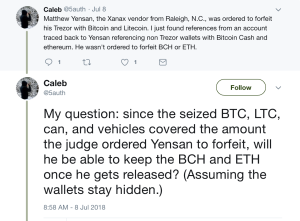
25-year-old Matthew Yensan, from North Carolina, was sentenced to 78 months incarceration today for producing Xanax and Alprazolam, selling them on the darknet and laundering the proceeds of crime using, inter alia, Bitcoin and Litecoin.

According to the indictment, Yensan had a Glock 27 .40, a Smith & Wesson Revolver .357, a Colt King Cobra Revolver .357, an MP-5.  All the guns were loaded. Agents also located a Trezor with 182 Bitcoin and two other cold wallets. Under his bed, agents found US$300,000 in cash.

After Yensan was indicted, DEA agents later located additional digital currencies – about double the original amount.

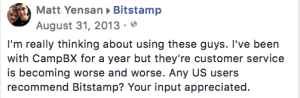
Yensan had posted a note on Facebook that he was thinking of using Bitstamp as his digital currency exchange, which is an unusual thing to do if one is a drug trafficker.

Apparently, the government has not located additional Bitcoin Cash and Ether held by Yensan.

Today’s Blockchain News from Asia

By Christine Duhaime | June 1st, 2018

업비트 압수수색: 가상화폐 거래소의 운영시스템 과 정부의 모호한 태도

By Eunji Lee

지난 5월 10일 서울남부지검 금융조사2부는 업계 1위로 알려진 업비트를 거래소 운영상의 불법 등 혐의로 압수수색을 실시해 업계에 관련된 많은 이들에게 혼란을 주었다.

검찰은 이틀동안 수사관을 보내 업비트의 컴퓨터 하드디스크와 회계 장부 등을 확보했다. 검찰수색의 이유는 업비트가 실제로 갖고 있지 않은 가상화폐를 가진 것터럼 전산시스템에 입력해 고객을 속인 것으로 보고 있었다. 이 압수수색에 앞서 금융위원회와 금융정보분석원 (FIU)의 합동 점검 결과에서 수상한 자금 이동이 포착된 가상화폐 업체를 중심으로 수사에 착수했다.  검찰에 따르면 업비트는 거래소 법인 계좌에 들어있는 고객 자금을 대표자나 임원 명의 계좌로 이체하는 식으로 고객 돈을 빼돌린 혐의를 받고 있다. 또 한, 가상화폐를 실제로 보유하고 있지 않으면서 전산상으로는 보유해 투자자를 속였다는 사기혐의도 적용된 것으로 알려졌다.

거래소에 대한 압수수색이 실시되면서 수사기관과 업비트의 대표 이석우의 악연이 다시 수면 위로 떠올랐다. 2014년, 검찰이 카카오톡을 감청해왔다는 사실이 알려지며 사회적으로 논란을 일었다. 이에 맞서 이석우 당시 대표는 “앞으로 검찰의 감청영장에 불응하겠다”는 초강수를 두면서 사이가 악화돼었다. 2014년 12월 경찰은 이 대표를 전격 소환해, 이 대표가 청소년성보호법을 위반했다는 혐의를 주장했다. 당시 이 대표가 카카오그룹을 통해 유포된 아동*청소년 이용 음란물에 대한 사전 조치를 소홀히 했다는 이유였다. 업계에서는 이 대표에 대한 일종의 보복성 수사라는 소문이 돌았다. 검찰과 사태가 걷잡을 수 없이 악화되자 그는 2015년 11월 돌연 카카오를 떠났었고, 약 2 년후 지난 12월에 업비트를 운영하는 두나무 대표로 다시 복귀했다. 하지만 컴백 반년만에 검찰의 압수수색을 받는 등 수사기관과 악연이 이어지는듯 하다.

업비트는 하루 거래대금이 1000억원대에 달하는 국내 최대 가상화폐 거래소다. 코인마켓캡에 따르면 업비트의 하루 거래량은 총 20억 달러 (2조 130억원)를 상회하는 규모다. 하지만 업비트는 개인이나 다른 거래소로 가상화폐를 전송할 수 있는 전자 지갑을 개설해주지 않아 가상화폐가 없는 것이 아니냐는 의심이 제기되 왔다. 현재 업비트에서 거래되는 137개의 암호화폐 중 46개가 전자지갑을 지원하지 않는다. 개별 전자지갑을 없기 때문에 암호화폐 거래 내용에 대해 거래소가 알려준 내용 외 따로확인할 길이 없다. 이에 대해 업비트 측은 “전자지갑 수가 가상화폐 수에 비해 적다는 것은 예전 이야기며 전자지갑 숫자도 종전보다 증가했다”고 강조했다.

암호화폐 거래소 업비트에 대한 압수수색 소식이 알려진 지난 11일 비트코인, 이더리움 등 대부분의 암호화폐 시세는 급락했다. 하락을 뜻하는 파란색이 가득한 시세창을 두고 일부 투자자들은 “다른 나라에서 한국 정부에 소송을 걸어야 하는 거 아니냐”는 반응을 보였다. 우리 정부의 모호함이 논란을 키우고 있기 때문이다.

中国国家主席习近平“拥抱”区块链

By Tongtong Xu

在5月28日举行的中国科学院第十九次院士大会、中国工程院第十四次院士大会上的讲话中,中国国家主席习近平肯定了中国目前在科技事业方面的进步。在提及人工智能以及量子信息、移动通信、物联网等为代表的新一代信息技术时,区块链,作为代表之一成为了讲话内容。

其实早在2016年中国国务院发布的“十三五”国家信息计划中, 区块链就被提及成为驱动网络空间演化进步的重要技术。国务院同时也表达了通过加强区块链技术的基础研发和前沿布局,建立先发主导优势的愿景。

对比2017年北京叫停国内的虚拟货币交易,并且在9月正式禁止销售新型的数字代币,同时也禁止了新ICO的发行。原本在这一系列的表态之后,比特币的价格以及中国地区区块链的应用都受到了一定短期冲击,然而习近平此次讲话对区块链技术表达出来的期望和赞许让区块链在中国的前景十分明朗。

事实上,不论政府的态度如何,区块链技术在中国的发展一直未曾停止。

Canada doing a lot worse combatting money laundering and drug trafficking according to 2018 US INCSR report

By Christine Duhaime | March 31st, 2018

Canada once again a “Major Money Laundering” country

The 2018 “International Narcotics Control Strategy Report” (INCSR) published in March 2018 by the U.S. Department of State identifies Canada once again as a “major money laundering country” along with a host of risky countries for financial crime, and is generally doing a lot worse combatting money laundering and drug trafficking.

A “major money laundering country” is one whose banks and financial institutions allow financial transactions involving significant amounts of proceeds of crime. For several years in a row, Canada has been identified as such.

Canada has also been identified as a “major precursor country” which means it is a leading country that produces precursors or essential chemicals used in the production of illicit narcotics, such as fentanyl. Other countries include Columbia, Nigeria, China, Afghanistan and Mexico.

Key Findings

Volume 1 - The key findings of Volume 1 on drug trafficking vis a vis Canada are that:

  • Canada is a primary source country of high-potency marijuana and MDMA to the United States.
  • Canada exports illegally, synthetic opioids to the United States.
  • Canada exports, illegally, synthetic drugs and amphetamine-type stimulants to Asia and Australia.
  • Cannabis destined for the US is produced mostly in British Columbia.
  • Methamphetamine continues to be produced in large quantities in Canada.
  • Canada increasingly illegally imports fentanyl from China via mail courier.
  • Recent seizures of multi-kilogram quantities of illegal fentanyl and carfentanil in powder form indicate these substances are increasingly manufactured illegally within Canada.

Volume 2 - The key findings in respect of money laundering  in Volume 2 for Canada are different in 2018, compared to 2017, and indicate a much greater global concern for money laundering in Canada.

The Report says, for example:

  • Foreign-generated proceeds of crime are laundered in Canada.
  • Professional, third-party money laundering is a key concern – this often includes accountants and lawyers.
  • Transnational organized crime groups and professional money launderers are key threat actors.
  • Canada does not do enough on enforcement and prosecution.
  • Laundering methods in Canada primarily involve cash smuggling, money services businesses, casinos, real estate, wire transfers, offshore companies, hawalas, credit cards and digital currencies, like Bitcoin.
  • The illicit drug market is the largest criminal market in Canada.
  • Transnational organized crime groups represent the most threatening and sophisticated actors.
  • Experts have noted that when the magnitude of money laundering risks in Canada is taken into account, the prosecution rate is low.