Canadian who was the 3rd largest fentanyl dealer, indicted in the US

By Christine Duhaime | August 23rd, 2018

Operation Darkness Falls nets Canadian fentanyl dealer

The US DoJ, Department of Homeland Security, the FBI, the US Postal Service and DEA announced several arrests in Operation Darkness Falls, an international operation that sought to ferret out the identities of people selling illegal drugs, especially fentanyl, on the darknet that accepted Bitcoin and other digital currencies for payment.

A Canadian in Vancouver named Robert Kiessling was arrested in Canada. He was vendor DF44 on AlphaBay, the Canadian darknet trading platform that facilitated the sale and purchase of illegal drugs, guns, weapons, stolen identities and such, using Bitcoin and other digital currencies. AlphaBay was started by Alexandre Cazes from Quebec.

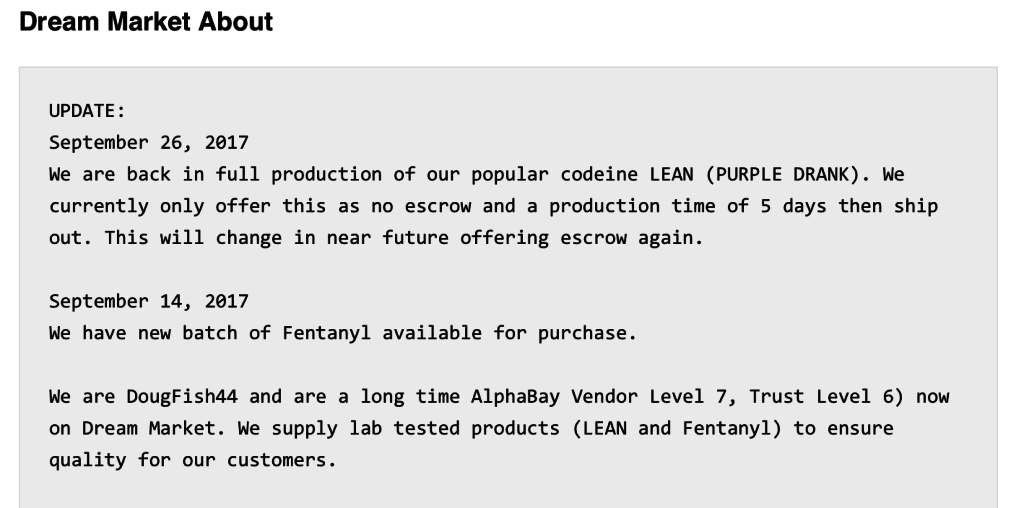
When AlphaBay was shut down by the US government, Kiessling moved to Dream Market. Under DF44, he openly promoted the sale of fentanyl (below). Kiessling committed suicide after his arrest before he could be extradited to the US. He was the 3rd largest fentanyl vendor in North America. Like the other Canadian who founded AlphaBay and was indicted in the US, Kiessling committed suicide after his arrest.

Largest fentanyl vendor also arrested in US

Also arrested were Matthew Roberts and Holly Roberts of San Antonio, Texas, who are alleged to have created and operated several darknet accounts, including MH4Life on Dream Market, Silk Road and on Canada’s AlphaBay to sell fentanyl, heroin, cocaine, marijuana, LSD, meth and other illegal drugs.

The Roberts are alleged to be the most prolific darknet fentanyl vendor in the US and the 4th largest in the world.

MH4Life seems to have known his identity was discovered on the darknet because he posted a “Code Red” post before being arrested (below).

Also arrested as part of Operation Darkness Falls were Americans Antoin Austin, known as Dark King 22, who pleaded guilty to operating a fentanyl business from an apartment with children and Ryan Kluth, known as Panachecak, who pleaded guilty to selling fentanyl and child pornography on the darknet. They both used Bitcoin for payment.

Bitcoin programmer and seller indicted in US for money laundering

By Christine Duhaime | August 19th, 2018

A Bitcoin seller was arrested in the US on Friday and charged with 31 offences including international money laundering, operating an illegal digital currency exchange, failing to have an anti-money laundering program in place and structuring transactions.

21-year-old Jacob Campos was a developer at Edge Wallet and a Bitcoin trader who sold Bitcoin in the US for 5% commission. He was a small player with a business that traded $900,000 in total, completed 971 transactions and had 900 customers. According to the indictment, he used US bank accounts to sell Bitcoin on behalf of clients without being registered with FinCEN as a money transmitting business.

According to the indictment, Campos had an account at the digital currency exchange Bitfinex during the time when Bitfinex had a bank account in Taiwan. Wells Fargo, the correspondent of Bitfinex’s former bank in Taiwan, indirectly derisked Bitfinex’s account as the correspondent. Bitfinex is believed to be a New York based digital currency exchange, with a corporate registered office in Hong Kong. Campos opened an account with Bitfinex, according to the indictment, after his account was derisked by Coinbase, another US based digital currency exchange.

Campos is a citizen of three countries and was held without bail after his arrest. His Facebook account is here and his Instagram account is here.

International money laundering case allegedly involving the ICO Dragon Coin

By Christine Duhaime | August 18th, 2018

According to the federal Thai police, as reported here in the Bangkok Post, the Dragon Coin (which is an ICO), was used for or was involved in it seems unwittingly, an international fraud and money laundering scheme. The Dragon Coin is an ICO allegedly launched with the involvement of a former Triad boss and money launderer named Broken Tooth (reported here by the South China Morning Post). The real name of Broken Tooth is Wan Kuok-koi.

According to the Thai authorities, a man from Finland, Aarni  Saarimaa, sent over 5,500 Bitcoin to invest in certain projects and part of the investment involved an investment in Dragon Coin. Saarimaa appears not to have used a third party escrow agent and the Bitcoin was allegedly diverted to seven Bitcoin wallets belonging to fraudsters who used some of it to buy land in Thailand. The rest was cashed out of a digital currency exchange (it is not known which exchange) and then transferred to 51 bank accounts held in the names of the alleged fraudsters. The bank accounts were frozen in Thailand but no action has been taken to freeze the Bitcoin wallets at the digital currency exchange.

An ICO is an initial coin offering meaning the issuance of a new digital currency that trades on certain digital currency exchanges. The Dragon Coin raised US$320 million from investors. According to a media report, Broken Tooth has moved on to develop a second Blockchain project in Cambodia whose purpose will be to offer services to casinos and promote Chinese culture. Since his release from jail for financial crimes and organized crime activities, Broken Tooth has become the chairman of The World Hongmen History and Culture Association, which connects Chinese foreign nationals internationally for business purposes.

China seizes $1.5 million in Bitcoin from wallets used for illegal online gambling

By Christine Duhaime | August 7th, 2018

The police from Guangdong province in China arrested more than 540 people in mid-July and seized more than $1.5 million in Bitcoin associated with illegal online gambling. Police also took offline more than 70 gambling apps and websites and shut down 250 chats for online gambling. In addition, $39 million in assets have been seized including computers, phones, cars, servers and such. According to Guangdong police, over 330,000 people participated in the illegal gambling operations and gambled over 10 billion Yuan.

Do foreign digital currency exchanges taking US customers online have to be AML registered in the US?

By Christine Duhaime | July 21st, 2018

Do foreign digital currency exchanges that take US customers online have to be AML registered in the US?

Not unsurprisingly, the answer is yes.

Under US law, digital currency ​exchangers​ qualify as money transmitters and are subject to the obligations under the Bank Secrecy Act. Key concepts to know are that:

  • An exchanger is a person engaged in the business of exchanging digital currencies for real money or other digital currencies.
  • And if an exchanger, e.g., a business, accepts and transmits or buys or sells convertible digital currencies, it is a money transmitter under the regulations issued by FinCEN.
  • If the exchange accepts but does not transmit, it is not a money transmitter.
  • If you are a money transmitter, you must then comply with the Bank Secrecy Act and the registration obligations of FinCEN.

If you are a foreign digital currency exchange, you must register in the US if you onboard US customers whether F2F or Non F2F, who are located in the US even if none of your agents, agencies, branches or offices are physically located in the US.

Is “I don’t know where the online customer is from” a defense?

There are sometimes arguments made that a digital currency exchange that operates online may not know if it is onboarding US customers because the Non F2F online registration process involves providing an email address only.

That argument may be problematic for an exchange because it evidences that the exchange may lack anti-money laundering law, counter-terrorist financing or sanctions law compliance to identify its customers. If it does not know where its customers are from, how can it know they are not from a prohibited country? If they do not know who their customers are, how do they know they are not on a list of terrorists?

Moreover, all exchanges record and track IP addresses that provide the location of a customer when onboarding, and have the technology to know where each customer is visiting from.

Obligations for foreign exchanges taking US customers 

So what then, are the obligations required for foreign digital currency exchanges that take US customers online from another country?

They must:

  1. Register with FinCEN;
  2. In whatever state you accept customers online, you must then register, usually as a money services business, with that state;
  3. Comply with the Bank Secrecy Act obligations including having a competent anti-money laundering program that is risk-based, report transactions including suspicious transactions, verify the identity of customers, undertake record keeping, appoint an AML compliance officer, train and audit the exchange’s systems and the AML program.
  4. Appoint a US agent for legal service who is physically located in the US.

In practice, the obligations require the digital currency exchange to verify customer identity, conduct due diligence on its customers, file reports with the federal government, and create and maintain records pursuant to the Bank Secrecy Act.

I think they should do more and require officers of digital currency exchanges to file periodic certifications to the bank confirming  compliance, as well as filing third party AML certifications.

Banks should also ask for legal sign offs in respect of ICOs and digital currencies mined, both of which are significantly more risky from an AML perspective to require that ICOs and mining pools confirm that the ICO or mining operation was launched legally and is not inconsistent with the securities legislation and is consistent with AML law.

Penalties

Foreign digital currency exchanges taking US customers are as liable as US exchanges for violations of US law. Last year, the US issued a civil penalty against BTC-E for US$110 million for willful violations of US anti-money laundering law and assessed a penalty of US$12 million against one of its administrators. What BTC-E did for Non F2F online onboarding was to obtain a username, a password and an e-mail address and once it had those, it conducted financial transactions by accepting digital currencies and fiat.

A foreign person employed at or controlling a digital currency exchange that is convicted of money laundering can face up to 20 years in prison and fines of millions of dollars. Any property involved in a transaction or traceable to the proceeds of the criminal activity, including property and bank accounts (even if some of the money in the account is legitimate), may be subject to forfeiture.

Compliance also requires that digital currency exchanges investigate financial crimes and when warranted, file suspicious activity reports. Failures by companies to investigate financial crime alerts and to submit SARs, have resulted in penalties of up to US$97 million by the US government.

Liability can often be personal as well, as against compliance officers who fail to comply with anti-money laundering law at their companies. Liability has not attached, however, in cases where the CAMLO’s function is underfunded or not funded, or there is no buy-in or support from the directors for a compliance department, although CAMLO’s are expected to resign in those situations. Regulators recognize that there are instances where a CAMLO is appointed and the appointment is for show only, meaning that there is no desire or resources allocated by the company for a CAMLO to be an operational position. CAMLOs are also expected to file a report when they depart over a failure of the compliance function at their company.

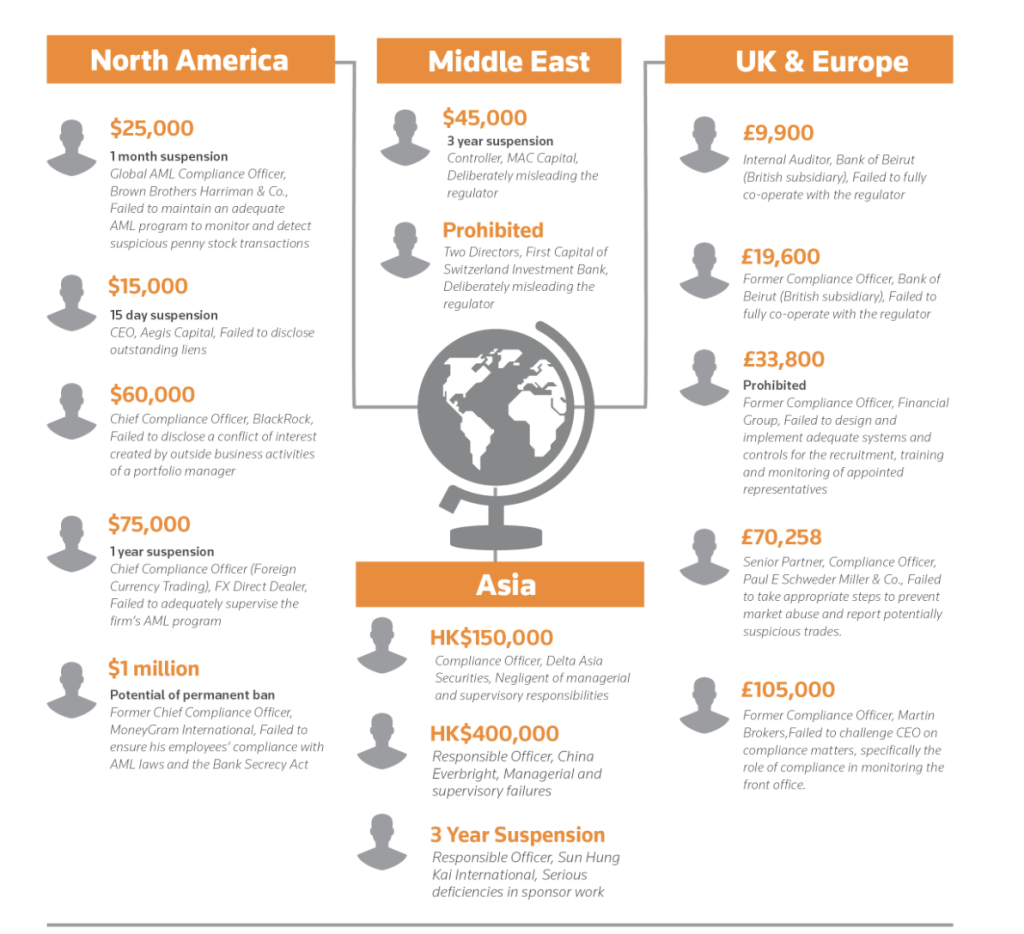
The chart below, from Thomson Reuters, provides some interesting cases of personal liability of CAMLOs.
US indicts 12 Russian nationals for money laundering and hacking

By Christine Duhaime | July 14th, 2018

The US has indicted 12 Russian foreign nationals for hacking, conspiracy and money laundering for allegedly interfering with the 2016 US presidential election. According to the indictment, Russia operated an intelligence agency called GRU which obtained confidential documents from the Clinton campaign systems by hacking and systematically released them to sway public opinion. According to the Indictment, the Russian hackers spoofed computers with fake Google emails to obtain access to computer emails and databases containing documents related to Hilliary Clinton and her presidential campaign.

The hackers, in what they believed was a move to avoid detection, used Bitcoin and the same Bitcoin wallet address to rent a server in Malaysia, register domain names and pay for other services. In total, they are alleged to have laundered $95,000 worth of Bitcoin in furtherance of their hacking activities. They also mined Bitcoin from their computers in order to pay for services. Unlike cash and other types of financial transactions, Bitcoin can be traced backwards online, even with tumblers and such, for financial crime purposes, and unlike traditional financial transactions, the identity of the owner of a Bitcoin wallet can also be determined.

清华大学计划将区块链技术应用于文物保护

By Christine Duhaime | July 13th, 2018

By Tongtong Xu

作为中国最高学府之一的清华大学日前递交了一项关于将区块链技术应用于文物保护的专利申请。

根据在4月递交,今天得到披露的专利,三位教员一同研发了一个区块链技术的系统概念,目的是储存并分享有重要意义的文物的数字版本。作为发明者的谭嘉嘉(音译)和陆小步(音译)向大家解释了这个系统的两个重要组成部分。

第一部分包括一个可以对重要文物进行扫描的3D计算模型,目的是在扫描之后能为储存提供一个数字范围的表格。在第二步中,该系统将每一项物品的数据通过一个叫做“Hashing”的加密过程自动储存在私有区块链上。

尽管专利申请并没有直接解释关于他们会如何开发该私有区块链的各方细节,发明者表明说初阶段的探索已在去年四月腾讯发布的区块链平台上进行测试。

See the full patent application below:

https://www.scribd.com/document/383768782/Tsinghua-University-Patent#from_embed?campaign=SkimbitLtd&ad_group=100652X1574425X38331168130bda0dedb41cbaf98a34f5&keyword=660149026&source=hp_affiliate&medium=affiliate

23 members of transnational criminal organization arrested for money laundering

By Christine Duhaime | July 12th, 2018

Europol announced today that the Spain and Columbia collectively arrested 23 members of an unidentified transnational criminal organization (the “Group”) involved in laundering the proceeds of crime on behalf of other unidentified transitional criminal organizations. The Group didn’t launder a lot of money – only €2 million.  The Group allegedly used Bitcoin to launder funds and part of the law enforcement action involved orders to freeze Bitcoin wallet addresses in Spain. The wallet addresses were set up in Spain for Columbian drug traffickers. According to Europol, drug traffickers used Bitcoin to hide the origin and movement of funds.  However, since they and the wallet addresses were located and the subject of what appears to be mareva orders, it’s fairly evident that Bitcoin financial transactions can reveal the identity of the transactors, as well as the transactions.

Woman who bought Bitcoin with $300,000 in cash in grocery bags, going to jail for one year

By Christine Duhaime | July 9th, 2018

A woman in California, who admitted operating an unlicensed in-person digital currency exchange where she traded cash for Bitcoin,  was sentenced today to 12 months in federal prison, three years of supervised release, and a fine of US$20,000.

Theresa Tetley pled guilty to conducting an illegal business and engaging in unlawful monetary transactions involving Bitcoin, and laundering the proceeds of crime. She was part of Localbitcoins.com and exchanged up to US$10 million for customers across the US. Her exchange was not registered with FinCEN and she had no anti money-laundering system in place, such as customer due diligence and transactional reporting of required financial transactions.

During one translation with an undercover DEA agent, she agreed to exchange the proceeds from illegal drug trafficking on the darknet. She had been de-risked by one bank and used her sister to conduct financial transactions for her.

She was arrested when she attempted to buy Bitcoin with US$300,000 cash that she had in two grocery bags.

Tetley was ordered to forfeit 40 Bitcoin, US$292,264.00 in cash and several gold bars.

Under US law, a money transmitting business must register with the federal government as a money services business, specifically, with FinCEN, which is part of the US Department of Treasury.

Registration as a money services business (“MSB”) triggers obligations for that financial institution. For example, under the Bank Secrecy Act, an MSB is required, among other things, to:

      • Develop, implement, and maintain an effective written anti-money laundering program that is reasonably designed to prevent the MSB from being used to facilitate money laundering and terrorist financing;
      • Report transactions that the MSB knows, suspects, or has reason to suspect are suspicious, including funds derived from illegal activity or involve the use of the MSB to facilitate criminal activity, if the transactions are conducted or attempted by, at, or through the MSB, and the transactions involve or aggregate to at least US$2,000 in funds or other assets; and
      • File a report of each deposit, withdrawal, exchange of currency or other payment or transfer, by, through, or to such MSB which involves a transaction in currency of more than US$10,000.

In practice, the obligations require an MSB to verify customer identity, conduct due diligence on its customers, file reports with the federal government, and create and maintain records pursuant to the Bank Secrecy Act.

In the US, digital currency exchanges that exchange Bitcoin for cash in person either comply with the law, and register with FinCEN (like traditional banks), or choose not to register with the federal government, or are perhaps unknowledgeable in respect of the law, as is the case with smaller companies in the new Bitcoin space.

Canadian Court orders transfer of 420 Bitcoin held by ICO founder, during Court hearing

By Christine Duhaime | July 9th, 2018

On Friday, a Quebec Court ordered the founder of an illegal ICO, Dominic Lacroix, to transfer $3.7 million worth of Bitcoin during a Court hearing and threatened him with incarceration if he did not immediately do so. Lacroix created the Plexcoin ICO which is the subject of an enforcement action by the SEC. According to the SEC, Plexcoin raised over $15 million from investors on the basis of alleged fraudulent misrepresentations to American residents. The ICO is illegal in the US and no decision has been rendered as to its legality or not in Canada. That’s because no court in Canada has determined Bitcoin is money and a provincial government has formally opined in respect of that.

Continue reading