FinCEN Employee Arrested for Illegally Disclosing SARs

By Christine Duhaime | October 19th, 2018

Arrest of FinCEN employee for SARs disclosure

The US government has arrested an employee of FinCEN for providing copies of suspicious activity reports (“SAR”)  to the media.

SARs disclosure is illegal 

SARs are required to be filed and submitted by certain reporting entities, such as banks, to FinCEN when the bank or its employees, have reasonable grounds to suspect that a financial transaction is associated with a money laundering offence.

SARs contain personal and private information of a person or a company and because they involve a subjective determination, can cause harm to a person or a business if filed without justification. As a result, the legislation protects the filer of the information and also protects the filing itself.

It is a criminal offence to disclose the filing of a SAR, or the contents of such to anyone other than FinCEN (or in Canada, FINTRAC). Reporting entities such as banks and casinos, that file SARs (STRs in Canada), are protected from law suits over wrongful filings provided they themselves do not violate the disclosure laws. The reason for the protection in respect of reporting entities such as banks is that they would not provide full disclosure if there was a possibility, however remote, that the public or the media would see a filed SAR. Reporting entities that give copies of STRs to other government agencies or to law enforcement in violation of federal law are not protected and such unauthorized disclosures can be compelled by anyone under privacy legislation because the disclosure thereof to unauthorized parties render them a non-protected document.

There is no protection over the investigation files, notes and documents, as well as SARs that are held with banks or other reporting entities, however, meaning that they can be compelled and have been compelled for litigation purposes.

Disclosure of terrorist financing reports

According to the criminal complaint, over the course of a year, the FinCEN employee, Natalie Edwards, allegedly provided SARs to a reporter and described the contents of several other SARs over Telegram. At first, she allegedly lied to the FBI and denied having supplied federal records to a reporter and then subsequently allegedly admitted it.

She is alleged to have saved 24,000 FinCEN files on a flash drive, including many SARs and records of a highly sensitive nature involving financial transactions of Iranian foreign nationals and terrorist financing of ISIS.
Oxymonster sentenced to 20 years for money laundering and dark net drug sales

By Christine Duhaime | October 10th, 2018

A foreign national from France, known on the dark net as OxyMonster, was sentenced to 20 years jail in the US for selling drugs such as fentanyl, online, and laundering the proceeds of crime. Gal Vallerius, 36, pleaded guilty to drug distribution and money laundering in Miami in June for selling cocaine, methamphetamine, fentanyl, oxycodone and other drugs on Dream Market where he was paid in Bitcoin.

Vallerius was arrested in August 2017, entering the US to attend a beard contest. In addition to selling illegal drugs online, he admitted to being an administrator of Dream Market. Part of the way he was detected was through his Twitter and Instagram accounts and by tracing his Bitcoin wallet addresses to Local Bitcoins.

Dream Market is a marketplace accessible on TOR, which has a tumbler service built in so that it is not possible to trace Bitcoin payments from buyer and seller.

He was arrested with 99.98 in Bitcoin and 121.98 in Bitcoin Cash under his control which was seized.

ICOs & tokens increasingly attracting FBI criminal attention

By Christine Duhaime | October 8th, 2018

According to this interview with FBI’s Financial Crimes Section Chief on CNBC, the FBI is seeing an increase in the number of complaints and cases opened involving digital currencies and crime. In particular, the FBI said that it is mostly ICOs and associated investment fraud schemes involving Bitcoin that are on the raise for investigations where retail investors (e.g., the public) is the target.

According to the FBI, criminals are increasingly using Bitcoin for crimes and as a result, the FBI is liaising with the Five Eyes to learn about digital currencies and crime. However, cash is still king for crimes because of the fact that there is always an intersection point when dealing with digital currencies.

7 Russian foreign nationals indicted in US for alleged money laundering and hacking of Canadian / US agencies

By Christine Duhaime | October 7th, 2018

The Department of Justice announced the indictment of 7 Russian foreign nationals in Pennsylvania for their roles in an alleged hacking of anti-doping sports agencies, including one in Canada called the Canadian Centre for Ethics and Sports. According to the indictment, the indicted persons hacked into computers for several years to allegedly influence sports doping and used Bitcoin to facilitate the payment of domain names and to use servers. According to the indictment, the defendants hacked into computers remotely from Moscow and also hacked into agency computers and mobile devices by gaining access to hotel and airport wifi networks. The defendants allegedly traveled to Brazil and Switzerland to hack hotel wifi networks to obtain log in credentials, and once they had access, they conducted large-scale exports of data. The indictment also alleges that the defendants acquired Bitcoin from mining, which offers a way to acquire Bitcoin relatively anonymously because the only connection point (and therefore identifying point), is the IP address.

You can read more here.

Hezbollah financier arrested for laundering $10 million at casino

By Christine Duhaime | September 22nd, 2018

An alleged financier for Hezbollah, Assad Ahmad Barakat, was arrested in Brazil, accused of laundering $10 million at a casino in Argentina. In 2004, the US Treasury said Barakat was one of the most influential members of  Hezbollah, a listed terrorist organization. It accused him of using his businesses in the border areas of Brazil, Paraguay and Argentina as a front for fundraising for Hezbollah as well as coercing local shopkeepers into giving money to the organization. Barakat is on the US sanctions list.

Paraguay has stated that it believes Barakat financed the 1994 attack in Buenos Aires that killed 85 people.

Iran using ghost supertankers to avoid sanctions law

By Christine Duhaime | September 22nd, 2018

According to this article in the Financial Times, Iran has sent a supertanker, called Happiness I, en route to Asia, carrying 2 million barrels of oil that is off-the-radar literally, in order to obfuscate that it is transporting Iranian oil to another country. When ships are off-radar, they turn off their transponders and are no longer broadcasting their positions.

Off-radar shipping by Iran is in response to the new US sanctions imposed against Iran that come into effect on November 5, 2018.

Although many EU nations appear to oppose the renewal of US sanctions against Iran, their opposition has little effect because oil sales involve the private sector (banks, law firms, insurance firms, refineries, accounting firms), and it is the private sector that needs access to US correspondent banks to survive. Engaging in commerce with Iran, including dealing with Iranian oil, is too much of a risk for the private sector. Even Turkey, which buys 7% of Iranian oil, decreased its purchases by 45%.

Officials are suggesting that the US government intends to ramp up sanctions enforcement against the private sector, mostly as against foreign banks with US correspondents or operations in the US which gives them jurisdiction, that facilitate sanctions avoidance involving Iran or Iranian foreign nationals.

New York AG releases integrity report on digital currency exchanges

By Christine Duhaime | September 20th, 2018

The New York Office of the Attorney General (the “OAG“) released a report yesterday on the integrity of digital currency exchanges. It sought the voluntary participation of exchanges including Bitstamp, Coinbase, Binance, Huobi, Bitfinex, Kraken, Bittrex, Gemini and Poloniex, among others. The OAG noted that Binance and Kraken declined to participate, citing the fact that they said that they do not allow trading from New York. The OAG suggested otherwise and referred them to the Department of Financial Services for potential violations of the law.

The key findings of the OAG are not positive. It found that:

  1. Protection of customer funds are often non-existent or limited at digital currency exchanges. The AG noted that digital currency exchanges lack audit standards and transparency and there is no independent auditing available to confirm statements made by digital currencies exchanges that they possess customer funds. The AG noted that customers are at risk of the unauthorized withdrawal of their funds and misappropriation.
  2. No safeguards exist at exchanges for integrity and surveillance of trading patterns.
  3. Owners and insiders of exchanges often trade on their own insider information and exchanges have no conflict of interests policy to protect customers.
  4. Some exchanges, which include Bitfinex according to the OAG, are not authorized to operate in the US and when it comes to anti-money laundering law, they do not comply with AML law when onboarding and seek, for example, only an email address to open an account and complete a financial transaction.
  5. With respect to sanctions and terrorist financing, exchanges usually use IP addresses to block certain countries but the OAG found that only Bitstamp and Poloniex used technology to combat VPNs to be able to confirm that they are not accepting financial transactions from sanctioned countries.
  6. Most exchanges do not have so-called formal bank accounts to allow fiat to digital currency trading. (A formal bank account is a corporate bank account in the name of the exchange. Some exchanges open bank accounts using names of other entities, or accounts in the name of a natural person to hide that they are an exchange.  That practice constitutes bank fraud in some countries).
  7. Some exchanges do not address manipulative or abusive trading activity.
  8. No exchanges have objective criteria with respect to listing ICOs for transparency and do not disclose fees charged to list an ICO.
  9. Data security is not tested at a few exchanges, including Bitfinex and Tidex.

Did Canada just seize enough carfentanil from an alleged drug dealer that could have been used to kill hundreds of millions of people?

By Christine Duhaime | September 2nd, 2018

Last fall, the police in Ontario arrested a person named Maisum Ansari who lives in the suburbs of Toronto, who had in his home approximately 42 kilograms of carfentanil, or a substance containing carfentanil.

42 kilograms of carfentanil is a massive amount and likely the largest seizure by law enforcement in the history of seizures of carfentanil. According to Europol, before the seizure in Canada, the largest single seizure of carfentanil was 440 grams seized in the UK in 2017.

Carfentanil is 100 times more potent than fentanyl. According to the AG of New Jersey, 45 kilograms of fentanyl is enough to kill 18 million people. A similar amount of carfentanil, at 100 times the potency of fentanyl, is enough to kill 100 times that number – which is somewhat less than 1.8 billion people, assuming it is of the same purity. And even if it is of a lesser purity, it is still enough to kill tens of millions of people. The purity in drug seizures typically ranges from 0.00034% to 0.13% carfentanil.

What a person in suburban Toronto was doing with that much carfentanil is unknown. And we also do not know where he got it from. There are no minimum doses of carfentanil that are known to be safe for humans. For the less potent fentanyl, the lethal dose is between 1-2 milligrams (which is similar to a few grains of salt).

Carfentani is a opioid sedative used for large animals, mostly elephants. It affects the central nervous system and depresses respiration. An overdose can cause respiratory arrest and death.

The amount of carfentanil seized in the home of Ansari suggests it may have been contemplated for terrorism-related purposes rather than drug trafficking because it’s simply too much volume. Carfentanil could be used by terrorists as a WMD and hence is a money laundering and terrorist financing concern under the FATF Recommendations for banks and the AML community who are tasked with safeguarding the financial system. Carfentanil is believed to have been used in Russia in 2002 in aerosol form to end a stand-off with hostages which resulted in the death of 117 people.

It’s not the first time Canadians have been identified as major players in the fentanyl and carfentanil trade – in late 2016, 50 million lethal doses of carfentanil were shipped to Canada from China, labelled as printer ink. Last month, the DHS, DoJ and FBI, among others, identified a Canadian man as the third largest fentanyl trafficker in North America. And Interpol issued an international wanted notice for a Polish gangster who was given immigration status in Canada named Wojciech Joseph Grzesiowski, wanted for trafficking fentanyl and carfentanil for the leading mafia organization, the Ndrangheta.

Europol and the European Monitoring Centre for Drugs and Drug Addiction reported that in 2017, 62 grams of carfentanil was seized in Vancouver, Canada, which originated in Hong Kong and transited through Germany.

As well, it was a Canadian owned and operated darknet site, AlphaBay, that facilitated most of the illegal drug sales, including fentanyl and carfentanil, online for quite a number of years until the US took them down.

Carfentanil and fentanyl have been linked to a significant number of overdose deaths in the US and Canada. Carfentanil is added to mixtures of heroin and cocaine and sold on the street.

Carfentanil and other fentanyl-related compounds are a serious danger to public safety, first responders, postal service employees and forensic laboratory personnel. It is also a significant health risk to bank employees who handle cash.

Ansari was charged with 337 offenses related to possession of illegal guns and possession of carfentanil for the purposes of trafficking. Later arrested was Babar Ali, who is alleged to be connected to Ansari.

Ansari is connected to Faisal Hussain, the man who killed two people and wounded thirteen others on July 22, 2018, in Toronto, using a semiautomatic gun.

Carfentanil is imported to Canada (usually Vancouver) from China illegally, paid for with Bitcoin, and then distributed to the US. More recently, it is believed that the CJNG in Mexico are pivoting into the fentanyl business because of the higher profit margins.

The World Health Organization just recently recommended that carfentanil be listed in the Single Convention on Narcotic Drugs.

Chemically, carfentanil is methyl 1-(2-phenylethyl)-4-[phenyl(propanoyl) amino]piperidine-4-carboxylate.

US and China continue joint investigation into fentanyl trafficking

By Christine Duhaime | September 2nd, 2018

This week, US and Chinese law enforcement announced the continuation of a joint investigation into fentanyl production and trafficking with a view to tackle the problem through money laundering investigations to identify TCOs involved.

As part of the announcement, China said that on September 1, 2018, it banned two fentanyl variants. In February 2017, China banned carfentanyl.

The DHS said that 35 persons have been identified and are in custody (but not named) that are associated with fentanyl trafficking in this specific case. Officials from the city of Xingtai, China, were in New Orleans as part of the investigation and announcement.

Two years ago, a 14-member delegation from the DEA spent a week in China meeting with Narcotics Control Bureau and Public Security Bureau officials in China to train them on investigating money laundering activities that would reveal fentanyl sellers.

Fentanyl is 50 to 100 times stronger than morphine, has been linked to hundreds of overdoses and deaths in the US annually, and over a thousand deaths a year in Vancouver, Canada. Fentanyl is often mixed into heroin and drug purchasers often have no idea that they’re taking fentanyl.

Illicit fentanyl trafficked in the US comes from Canada, China and Mexico. Xingtai is a key city in China where fentanyl is manufactured. Vancouver is a key city in Canada where fentanyl is shipped to before heading to the US.

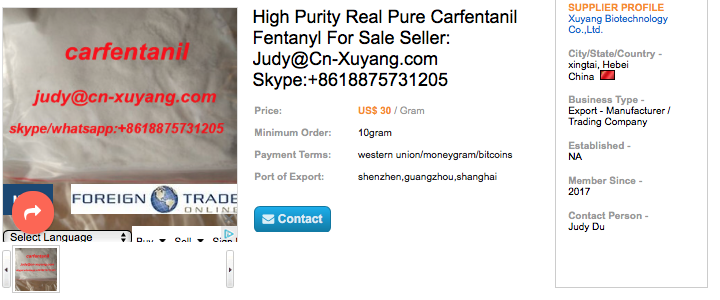
Fentanyl from China is often paid for with Bitcoin (see online ad below from Xingtai for the illegal sale and export of carfentanil for payment in Bitcoin although the ad may be a plant because the price for a gram of carfentanil is not $30 and no one is named “Judy” in China, for real or for cover).

US indicts two Chinese foreign nationals for operating criminal enterprise, international money laundering and selling fentanyl

By Christine Duhaime | August 26th, 2018

The US Attorney General, Jeff Sessions, announced the unsealing of a 43-count indictment against two foreign nationals from China for allegedly manufacturing, advertising, selling and shipping fentanyl, carfentanil and other deadly drugs to several countries including the US and Canada, which resulted in the deaths of American citizens. They are also charged with operating a criminal enterprise and money laundering.

The charges carry a term of life imprisonment because of the deaths of Americans attributable to their alleged importation of fentanyl.

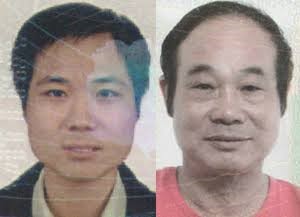
Indicted were Fujing Zheng and his father Guanghua Zheng, from Shanghai, China.

The DHS, DEA, IRS, Postal Service and FBI worked on the case and reiterated at a news conference that the “DEA will relentlessly pursue anyone shipping deadly fentanyl to the US wherever they may be and bring them to justice.”

The indictment alleges that the Zhengs used numerous companies, including Global United Biotechnology, Golden Chemicals, Golden RC, Cambridge Chemicals and Wonda Science to manufacture and distribute hundreds of controlled substances, including fentanyl and carfentanil and maintained numerous websites to advertise and sell illegal drugs in more than 35 languages, shipping over 16 tons of chemicals every month from its own laboratory. They also allegedly made and shipped K2 and spice, drugs that are of growing concern for overdose deaths.

The Zhengs are also alleged to have agreed to make potent anti-cancer drugs illegally and ship them to the US.

The Zhengs laundered the proceeds of crime using Bitcoin and Litecoin and cashed out into bank accounts in China and Hong Kong, including the China Merchants Bank in Hong Kong. Drug traffickers were asked to say wire transfers to the China Merchants Bank in Hong were for “tuition.”

According to the indictment, the Zhengs used a number of digital currency exchanges outside of China and wallets to receive proceeds of crime from foreign drug purchasers. They also frequently used Skrill to launder money and receive drug payments for fentanyl.

According to the indictment, they set up companies in the BVI, the jurisdiction favored for money laundering and tax evasions by wealthy Chinese foreign nationals.

Neither Zheng is in the US and once located, will have to be extradited to the US.