G20 adopts a “zero tolerance” against corruption and agree to close all loopholes and join forces for asset recovery of proceeds of crime on an urgent basis

By Christine Duhaime | September 12th, 2016

The G20 agrees to cooperate over asset recovery and tracking down wanted foreign nationals implicated in financial crimes

The G20 released its statement on September 5, 2016, and a large part of it indicates that the leaders of the world are becoming concerned with financial crime, including money laundering, terrorist financing and tax evasion.

The financial crime agenda was expanded to address concerns of flights of capital, the abuse of the financial system to export and move illicit funds from one country to another and shadow banking.

Shadow banking concerns

The G20 leaders said that they will be monitoring shadow banking, flights of capital and ways in which individuals and entities use the banking system to move money internationally and will address the risks to the financial system that arise from those activities. One of the ways they committed to address flights of capital and the movement of illicit funds is through better sharing of tax information with the lead coming from China who is opening up its tax database for asset recovery the Statement said, to achieve tax transparency.

Beneficial ownership disclosure is “vital” to protecting the integrity of the financial system”

The G20 leaders focused on beneficial ownership concerns – a term that means when people make legal structures to obfuscate who controls private companies (the shareholders or controllers behind the shareholders). As noted by the G20, understanding beneficial ownership is “vital to protecting the integrity of the international financial system” and to preventing its abuse.

Money laundering harms people

The G20 recognized that corruption, money laundering and the illicit flow of money to other countries is inconsistent with the rule of law and has a detrimental effect on the fair allocation of public resources on people. They stated that corruption, money laundering and the illicit flow of funds hinders economic growth and affects the integrity of the financial system.

G20 to assist in asset recovery

The G20 countries said that they will each assist in asset recovery and in the pursuit of persons wanted for corruption. At the G20, China announced that is was setting up a Research Center on International Cooperation Regarding Persons Sought for Corruption and Asset Recovery in the G20 countries.

Denial of safe haven

The G20 also said it would continue its policy of “denial of safe haven” of people immigrating to countries with proceeds of crime. The G20 stated it would share information with border agencies to enforce the denial of a safe haven, and will work with judicial authorities as well and start to aggressively use extradition measures to remove corrupt persons so that they are subject to justice in their own countries. According to the G20, this is an urgent matter.

Zero tolerance

The G20 also agree to information-share about foreign nationals who are suspected of financial crimes with law enforcement agencies. The statement said that they now have a “zero tolerance against corruption, zero loopholes in its institutions and zero barriers in taking action”.

Corruption in P3 infrastructure deals

In addition, the G20 addressed for the first time, the financial crime risks that arise from the practice of asset management, where the private sector is charged under long-term contracts with the responsibility for managing assets that belong to the public (such as highways, airports and such). According to NGOs, asset management arrangements that are contracted for under P3 procurement processes are at a higher risk for corruption and money laundering on the part of the funds that manage the assets – they is because they tend to be politically exposed persons and sometimes have anti-competitive arrangements.

Correspondent banking reduction

Not all the statements from the G20 were consistent or made sense from a financial crime perspective. The G20 said they support the reduction in correspondent banking but that move would increase financial crime activities and reduce the oversight of US regulators over the entire financial system, resulting in fewer prosecutions of financial crime.

FBI – “No safe haven anywhere for money launderers” – The fascinating $1B 1MDB civil asset forfeiture case

By Christine Duhaime | August 21st, 2016

Largest civil asset recovery case in US of this kind

On July 20, 2016, the US Department of Justice filed a civil forfeiture case in California to recover assets of more than $1 billion in alleged proceeds of crime resulting from fraud allegedly committed by individuals associated with the Malaysian government’s 1Malaysia Development Berhad (“1MDB“).

According to the civil complaint, proceeds of crime were funneled through the US financial system and allegedly parked in expensive real estate in the US and London, and used to buy a Canadian Bombardier jet ($34,000,000) and expensive works of art ($200,000,000), and used to finance the film “The Wolf of Wall Street”, to pay for VIP high rollers to gamble in Las Vegas ($25,000,000), to buy expensive diamonds ($3,000,000), and alleged elsewhere, to finance the Omnia nightclub in Las Vegas (summary here and copies of email evidence and more detailed fascinating story here).

Bank assets and real estate frozen globally

Bank accounts in multiple countries in the names of individuals and private companies were frozen while the investigation continues and the trail of funds can be ascertained, which may take a year. In July 2016, the Singapore MAS seized $240 million in connection with 1MDB, half of which was allegedly held by Jho Taek Low (see below).

The essence of the civil complaint is that a few politically exposed persons (“PEP“) from Malaysia, the US and the United Arab Emirates raised funds through bond issuances for Malaysia intended to grow its economy and diverted the funds raised for their personal use or for the use of private companies they legally owned or beneficially controlled. While the allegations are based on criminal activities, no criminal complaint was filed although the alleged criminal conduct is being used for the basis of the civil asset recovery.

One of the key PEPs is Khadem Al Qubaisi, the former director of the International Petroleum Investment Company, Abu Dhabi’s sovereign-wealth fund. He was also the Chairman of a company called Hakkasan Ltd., which owns the Omnia nightclub in Las Vegas. He was arrested last week in Abu Dhabi and his assets are frozen.

Jho Taek Low

Jho Taek Low, a Malaysian PEP, originally based in Hong Kong, is one of the alleged actors involved in the 1MDB scandal named in the US civil forfeiture case. The South China Morning Post reported that Low has begun to sell expensive pieces of art. He allegedly runs several companies, Jynwel Capital, Batumba Investments Limited Hong Kong, Good Star Limited and Wynton Capital. According to some reports, he allegedly used part of the alleged proceeds of crime to arrange for expensive diamond purchases for Malaysian PEPs.

United Nations

The organizations that received the alleged proceeds of crime include the United Nations Foundation and the UN agency, IRIN, which said that it received over $2 million from Low’s organizations.

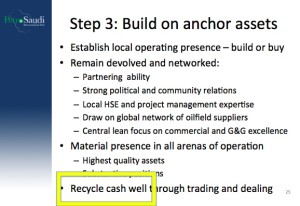
“Recycle cash well” 

In a PetroSaudi Powerpoint connected to the IMBD scandal that was allegedly used to raise the initial funds … the final step of the plan was to “recycle cash well.”

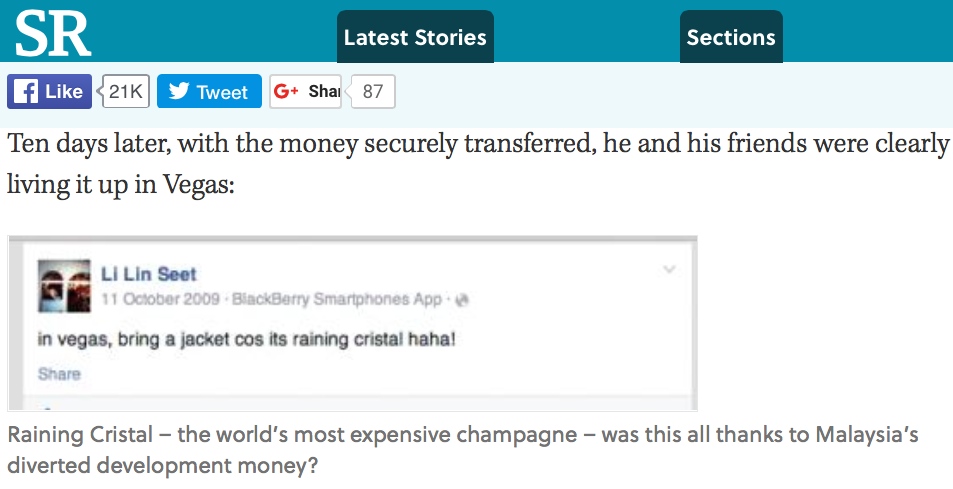
“Raining Cristal”

According to one website, when the first 1MDB funds were allegedly paid out to a company controlled by Low, his colleagues allegedly posted on Facebook that it was “raining Cristal haha!” (i.e., champagne) in Las Vegas.

The legal basis for the claim

The legal basis for the civil asset recovery action is a civil action in rem to forfeit assets in other countries, as well as the US, involved in and traceable to money laundered in the US pursuant to 18 U.S.C. §981(a)(1)(C), on the ground that it was derived from violations of US law, and pursuant to 18 U.S.C. §981(a)(1)(A). The US claims jurisdiction pursuant to 28 U.S.C. §§1345 and 1355.

The legal basis also is that the defendants’ asset are property that constitute or are derived from proceeds traceable to one or more violations of foreign criminal offenses involving fraud by or against a foreign bank, wire fraud, international transportation or receipt of stolen property or fraudulently obtained property, receipt of stolen money, and misappropriation of public funds by or for the benefit of a public official and is capable of forfeiture under 18 U.S.C. §981(a)(1)(C).

Harm was to US financial system

The action is interesting from a number of perspectives, including that it is a civil, as opposed to a criminal, action. No American natural or legal person was harmed by the alleged money laundering scheme. The basis of the action is that the US financial system was used to launder money and it – the financial system – was harmed by virtue of the fact that it was used (and abused) for money laundering purposes.

FBI – We will “deny money launderers safe haven wherever they may be” 

The action is also interesting because the US government said it would: “be relentless in efforts to deny money launderers the proceeds of their crimes” wherever they may be and to ensure they have “no safe haven”.

The US government went on to say: “public corruption, no matter where it occurs, is a threat to a competitive global economy … we cannot allow billions of dollars to be laundered through US financial institutions without consequences,” explaining that the FBI is working with foreign countries to return stolen assets.

US expands review of money laundering in real estate market

By Christine Duhaime | July 30th, 2016

More scrutiny in US for real estate

The Financial Crimes Enforcement Network (FinCEN) announced that it is expanding its program to identify persons who may be hiding assets in residential properties in the US. The expansion adds additional cities to what are called the area for Geographic Targeting Orders (GTO). Title insurance agents in GTO cities are required to identify the people behind private companies if they pay “all cash” for high-end residential real estate. All cash means mortgage-free.

The US said it is concerned that all-cash purchases may be used to launder proceeds of corruption by parking funds into real estate through the use of what are called beneficial ownership structures.

“Luxury real estate vulnerable to money laundering”

The initial GTO program stated in the US earlier this year yielded a “significant” number of cases to the US government of “possible criminal activity” associated with real estate transactions. The US government has said that it is concerned that” luxury purchases of residential property are highly vulnerable to abuse for money laundering” and that the expanded program will help the US learn more about money laundering risks in the national real estate markets, helping to form future regulation.

At least 25% of the GTOs filed since March 1, 2016, as part of the initial GTO test, revealed suspicious names associated with luxury real estate transactions in Manhattan and Miami – the two cities that were part of the GTO pilot.

The GTO program captures just all cash transactions because when mortgages are involved, it is banks who are required to perform the vetting process of identifying and reporting financial crimes associated with mortgages.

FBI wins appeal to hack into your personal computer for serious criminality

By Christine Duhaime | July 2nd, 2016

Right to hack any computer anywhere for serious criminality with underlying court order

In a case that seemed to be quite sweeping, the US government has won an appeal to use evidence in a criminal proceeding derived from hacking into personal computers, regardless of where situated (a home, a corporation, a cafe, an airport) for the purposes of identifying and prosecuting serious criminal activities.

It seems, pursuant to the case, that there is no need for the computer (e.g., you) being hacked to be owned or controlled by a US national (person or corporation) except that the underlying warrant authorizing the activity may be tied to US persons (natural and corporate, or which have a tie to the US).

The case, US v. Matish, did not involve terrorism, like the FBI- Apple case; rather it involved child pornography and child exploitation websites. According to the case, the FBI has been collecting evidence from a large number of national and international people for the purposes of future prosecutions for serious criminality. But they have not acted on those prosecutions yet and the targets in the US and other countries have no idea that the US government has evidence of them on file for prosecution purposes yet.

Facts

The facts of the case are as follows:

  • Edward Matish, a US citizen, was charged with accessing the Internet with an intent to view child pornography and receiving child pornography from a website called Playpen.
  • Playpen was on the TOR network which allows anonymous viewing of websites by hiding the IP address of a person using the Internet, which can locate the person geographically.
  • Playpen had 150,000 members.
  • The FBI took over Playpen from its creator and was authorized by a court order to deploy an investigative technique that allowed it to find out the identity of any user of the site, and where they lived (so, they were traceable like any porn regular non-TOR site). The information the FBI could obtain from the tech it created included the IP address of a person and the media access control address of their computer, so that if you moved locations, you could still be located.
  • In essence, the FBI gained access to a person’s computer through TOR and downloaded coding to obtain their computer address and then uploaded certain information back for the purposes of prosecution (e.g., who you are and where you are).

Matish sought to force the FBI to disclosure their investigation techniques and the tech (programming code) developed to access his home computer, and he sought to have the evidence inadmissible on numerous grounds including his 4th Amendment right against search and seizure, and his reasonable expectation of privacy when using his computer at home from FBI intrusion.

The government successfully resisted on the grounds, inter alia, of security because it would expose their techniques and make it useless to track Internet crime, and on the ground of law enforcement privilege because revealing their tech would diminish the future value of important techniques that protect the public.

No expectation of privacy with your computer

With respect to the expectation of privacy, the Court held that people cannot reasonably expect to be safe from hackers, including those using the TOR network.

The Court held that the FBI gaining access to one’s computer using TOR is identical to a police officer looking through broken blinds of a person’s home, and thus no 4th Amendment right was violated.

The Court noted that since no computer is hack proof, “people who traverse the Internet understand the risks associated with doing so.” The FBI’s action on TOR was akin to merely peeking through blinds when they downloaded code to a person’s computer and watched their activities in their home, and gathered information they needed to prosecute.

Government authorized to use most advanced tech for criminal investigation for terrorists and child porn

The Court further held that “the government should be able to use the most advanced tech to overcome criminal activity that is conducted in secret, and Defendant should not be rewarded for allegedly obtaining contraband through his virtual travel through interstate and foreign commerce on a TOR hidden service.”

“The government’s efforts to contain child pornographers, terrorists and the like cannot remain frozen in time; the government must be allowed to utilize its own advanced tech to keep pace with our world’s ever-advancing technology and novel criminal methods.”

The way it works is that the users of TOR sites that involve serious criminality that are hacked by the FBI (and there are thousands thus far), will be identified for criminal purposes and those that involve US citizens will be prosecuted and those that involve foreigners (Canadians) will be referred to the RCMP.

If I were to guess, based on that case, I would say that the FBI is creating a database of persons around the world with their IP address, media address, name, IP service provider, location and a site visit profile.

While that may seem freighting to some, it is much more palatable than companies in the private sector who attempt to do the same for commercial purposes in violation of privacy laws, who sell the personal data collected, or information related to personal data, to foreign countries.

P3 infrastructure criminal charges in Canada against a politically exposed person

By Christine Duhaime | June 29th, 2016

The RCMP has charged a former head of a Crown corporation, Michel Fournier, and his wife, Judith Fournier, both resident in Victoria, with money laundering in connection with alleged corruption from kickbacks they allegedly received tied to a $127 million contract to renovate the Jacques Cartier Bridge. Fournier had a secret bank account in Switzerland with millions of dollars in it and is a politically exposed person (“PEP“).

At the time he was banking in Switzerland, Fournier was a foreign PEP to Swiss banks and was subject to higher due diligence scrutiny and vetting of funds under international anti-money laundering laws.

Corruption occurs frequently enough in large infrastructure projects, including in Canada. The largest corruption and money laundering case in Canada involved infrastructure with the McGill University Hospital Centre, a public-private partnership arrangement (P3) in which another PEP, Arthur Porter, was paid a bribe for a contract. In February 2014, the late Minister of Finance said that infrastructure in Canada has”fallen prey to corruption.”

According to the OECD and FATF, P3 project are more susceptible to corruption is they have the following characteristics:

  • Lack of due diligence by financiers on, inter alia, financial crime including involvement of politically exposed persons, domestic and foreign.
  • Large projects with greater complexities or novel features.
  • Lack of transparency in the process.
  • Too much discretionary decision-making authority exercisable by several officials.
  • Unclear rules and regulations in respect of financial control and audits.
  • Lack of awareness of financial crimes.

The FATF has determined, with respect to PEPs, that there is a greater risk with persons involved in the following:

  • Energy, construction, gaming, mining and defense sectors;
  • Large infrastructure projects; and
  • Financing of government projects.

The Competition Bureau of Canada recently expressed concern in Canada over the potential financial crime risks with infrastructure projects because financial crime negatively impacts competition and creates an unfair playing field.

Fournier was politically exposed because he ran the Federal Bridge Corporation, a federal agency.

Iran renews calls for the deportation of Khavari

By Christine Duhaime | June 19th, 2016

The requested deportation of Mahmoud Reza Khavari, a former Iranian foreign national, and a Canadian citizen living in Toronto, seems to be at the centre of the arrest of a Canadian professor from Montreal, Homa Hoodfar, also an Iranian foreign national and equally a Canadian citizen, who was visiting Iran.

Professor Hoodfar was arrested by the Revolutionary Guard in Tehran just before Norwuz and is alleged to be incarcerated in Evin prison in Northern Tehran. The Canadian government has sought her release from Iran. The government of Iran has countered with its renewed requests for the deportation of Khavari.

Khavari 

Some background on Mahmoud Reza Khavari. He was prosecuted in Tehran for participating in the embezzlement of US$2.6 billion from the Melli Bank, a state-owned bank in Iran (Washington Post). It is the largest bank theft in Iran and its largest money laundering case, although it was not prosecuted on the basis of money laundering.

Khavari fled Tehran and came to Canada. Prior to that, however, he was granted citizenship of Canada in circumstances that seem unclear since he appears to have been living full-time in Tehran running a state bank and could not therefore have met the residency requirements under the Immigration and Refugee Protection Act to earn the right to citizenship.

Khavari purchased a mansion on the Bridal Path in Toronto, which is like having a mansion in Elahiel in Northern Tehran, only with a yard.


According to court filings, Khavari is alleged to have told a Toronto friend that he has “vast financial resources”. It turns out that Khavari was actively investing in Toronto – he invested $14.2 million in the construction of two Toronto luxury condominium buildings (Financial Post) and he has interests over them (they are at 131 Hazelton Avenue, 195 Davenport Road and part of 145 Davenport Road in Toronto) (2011 ONSC 101)

Also according to those court filings, Khavari assumed the name “Khalili” when he moved to Canada to conceal his true identity.

The US$2.6 billion taken from Iran was never recovered.

The government of Iran has sought the deportation of Khavari for many years from Canada without success; prosecutors in Tehran omitted to charge Khavari with money laundering in Iran, which would have accelerated his removal. While Iranian agents have visited Canada and physically searched for Khavari in Ontario, also without success, it now turns out that his address has been published in Court documents filed in Ontario in connection with a civil litigation in which he is embroiled (Financial Post). Iranians in Toronto say he lives openly in the community in a mansion in Toronto.

Iran has called the refusal of Canada to return Khavari to Iran as “one of the biggest hostilities of Canada towards Iran” (Fars News Agency), in part because allegedly Canadian officials misled Iran as to the whereabouts of Khavari, claiming that he was no longer living in Canada when he was in Toronto.

Anti-money laundering law & sanctions law 

Khavari was the Chairman of the Melli Bank, hence he and all his family members are foreign politically exposed persons, subject to anti-money laundering heightened due diligence that required that the source of all their wealth be ascertained when they opened bank accounts in Toronto.

Salaries in Iran are about 30% what they are in Canada so salaries on bank applications that don’t reflect that are of concern to banks. Iran was subject to sanctions after 2010 which prohibited any bank or brokerage firm, in fact any person, from doing anything but freezing funds of Khavari that originated from Iran after 2010 unless it was approved by the Canadian government. To avoid sanctions, Iranians typically move their money  through Dubai. Obfuscating the original of money from Iran through banks in Dubai does not make the funds sanctions-free — it does the opposite, it makes them proceeds of crime, the predicate criminal offense being sanctions avoidance.

Dual citizens with dual passports

Iranians often have two passports to facilitate their travel and often it is so that they can enter the United States as Canadians, without disclosing to US border agents the existence of their Iranian passports, and enter Iran as Iranians, without disclosing the existence of their Canadian passports to Iran’s border control agents.

The political situation between Canada and Iran became more complicated and tense because of the $13 million judgement against Iran awarded by a Toronto Court last week (National Post) for American plaintiffs.

The CIA on terrorism and tech

By Christine Duhaime | June 18th, 2016

On June 16, 2016, the Director of the CIA testified before the Senate Select Committee on Intelligence in respect of the Islamic State (ISIS), terrorism and technology generally.

Here is an executive summary:

  • The CIA said there there has never been a time when there is such a “dizzying” array of national security issues and threats affecting countries;
  • The so-called “Twitter Terrorist” and terrorist propaganda phenomena poses an international security threat and such propaganda takes place mostly on Twitter, Tumblr and Telegram, working to inspire attacks by sympathizers globally to harm the West (to learn more, you can read our research here);
  • ISIS is still able to raise tens of billions of US$ per month in revenues;
  • Libya is now ISIS’ most developed and dangerous jurisdiction, followed by Egypt. The Libya branch of ISIS is actively planning attacks in the EU;
  • ISIS will be moving with groups of migrants and refugees to access the West;
  • The US financial system (its banks and financial institutions) are under serious threat of cybersecurity threats;
  • The rebuilding of Syria will take billions and billions of dollars;
  • The digital realm, including mobile and online activities, pose the most challenge to the CIA and other intelligence agencies. The CIA called digital challenges a “new frontier”, noting that the law has not kept up with those challenges; and
  • The Internet of Things (IoT), where every type of electronic and mobile device will be connected to the Internet will create inherent security risks to the US.

With respect to national security solutions, the Director of the CIA said that the agency is (a) embracing diversity and ensuring that it has women in leadership in the intelligence community; (b) working with the EU over threats to terrorism and on the issue of social media propaganda promoting terrorism, and the movement of prospective terrorists to the EU; and (c) working with the tech private sector to advance the national security interests to ensure that the tech companies are aware of their responsibilities in respect of national securities issues and are cooperative.

FinTechs are being derisked out of bank accounts over terrorist financing and money laundering risks says UK study

By Christine Duhaime | May 29th, 2016

The Financial Conduct Authority released an interesting soft study on the incidents of derisking affecting companies in the UK and pursuant to the study, MSB, charities and FinTechs are the three business client groups whose bank accounts are most frequently closed because they are too risky for the bank (a practice known as derisking). No business, least of all a FinTech, can survive for very long without a bank account.

By way of background, banks are required by complicated anti-money laundering, counter-terrorist financing and sanctions laws to implement robust legal compliance programs that include, inter alia, the appointment of an experienced compliance officer, the undertaking of a geographically tailored risk assessment, regular company wide training, and a reporting regime for suspicious transactions tied to enumerated predicate offenses under national criminal law statutes, tax statutes, terrorism statutes, UN Conventions, sanctions statutes, and anti-corruption statues, and the reporting of certain transactions. The requirements are based on national laws and vary by country.

The costs of compliance for any reporting entity is at least $1 million per year, regardless of the size of the entity. Across the board, reporting entities in most countries agree that that is the baseline cost and it goes up based on the size of the financial institution. Large banks have compliance costs in the tens of millions of dollars per year. The costs is the same, in terms of a baseline amount because all reporting entities regardless of size have similar basis requirements that are costly to implement.

Diving into the minutia of costs, banks in the survey disclosed that it costs them annually between $4,200 to $6,400 (converted to CDN) per account holder to meet its AML / CTF compliance obligations. Those costs are not being passed onto the actual bank clients but rather are absorbed by the banks as part of its costs of operations. A FinTech paying $4,200 to $6,400 per month for the actual costs of compliance would have to raise money to match the actual costs of doing business. Based on many financing documents in the FinTech space, a number of FinTechs pay large monthly management fees to their insiders and next to nothing for legal compliance. That makes the FinTech risky for any bank or investor.

The AML / CTF requirements are similar across all reporting sectors, whether the reporting entity is a casino, a bank, a stock broker, a realtor or an MSB or a FinTech that is a reporting entity, and the costs incurred by each group should also be the same to comply with AML / CTF law. But its not. Typically, only land based casinos, some investment firms and banks tend to implement the full suite of AML / CTF legal requirements. The rest of the sectors of reporting entities fall short.

And so the derisking problem is this: all companies (including charities, MSBs and FinTechs), have to have banking relationships and bank accounts for their business and to complete financial transactions on behalf of their customers. The banks who provide those banking services are on the hook for AML / CTF compliance failures for banking the little players and therefore carry the risk of the banking relationship. The risk is a regulatory risk,  a civil liability risk and a risk of criminal liability for AML / CTF failures, not only of the bank but also of its officers and directors. As noted in the study, banks also have a real concern with the media backlash and reputational damage to them if  it were to emerge that banks participated in banking a FinTech that was involved in a financial crime scandal, or funded a terrorist organization inadvertently by not being familiar with well-known typologies.

FinTechs that onboard customers and conduct financial transactions do not spend $4k – $6k per customer per year, like banks do, in AML / CTF compliance costs. For banks, that means that the bank now has a double compliance burden of being concerned with its own compliance and the compliance of the FinTech and thus its costs escalate.

In the banking relationship, FinTechs are essentially asking banks to trust that the FinTech management will be legally compliant in respect of AML / CTF. Banks are saying: “No, show us on paper that you know what AML / CTF involves so that we have comfort that your FinTech is not a risk to us.” AML / CTF compliance lawyers working at banks are not willing to lose their job, pay a huge fine or be prosecuted for a FinTech’s AML / CTF failures.

Every bank does a risk assessment of a FinTech, which they will never share with you if you’re a FinTech but you can rest assured that if you are derisked, its because your startup, your management team, or your control systems (or lack thereof) was deemed too risky to the bank. Sometimes its not the FinTech that is risky but its the people behind a FinTech financing that are of concern to a bank, such as unlicensed individuals who raise money for startups and take financing fees off the books. Banks are also adverse to banking FinTechs that have ties to jurisdictions associated with offshore gambling operations that operate in some countries illegally.

FinTechs that do not know AML / CTF law or who know it but fail to comply because they costs are prohibitive for a startup or because they prefer to use their financing funds for other purposes, are too risky for a bank to bank and consequently they are derisked and their bank accounts are terminated.

I’ve heard from a number of chiefs of innovation at the world’s largest banks in the leading FinTech cities that FinTechs often approach them to partner or for investment without having spent time understanding the legal environment in which banks operate, and often they have already developed sophisticated tech that may be amazing but which a bank could never use because it would not mesh with the law. A FinTech that invests in tech but not the legal requirements for applying that tech is risky to a bank and signals that its house is not in order.

Many FinTechs operate with contracts in place with banks whereby, if they are partnering with a bank, the AML / CTF obligations remain with the banks, rather than the FinTechs. Others have no contracts in place and the banks in those partnerships have decided that since FinTechs are not registered as reporting entities, or registrable with the FIU, AML / CTF laws are suspended in respect of those transactions (although that is not the law). Many other FinTechs and banks are struggling to carve out the obligations in respect of AML / CTF to ensure that responsibilities and liabilities are clearly defined and that the risks are borne by one of the parties for AML / CTF failures.

In addition to contractual risk allocations, the solutions may be to pass on the actual costs of compliance to each business customer so that banks quit derisking and the FinTech carries the true costs – a move supported by the UK government in the study; and to have a regulatory sandbox to allow FinTechs to innovate in a controlled bubble where there is no potential harm to the financial system by their failures to comply with AML / CTF law because their financial transactions are limited in volume and transactional number, and subject to different oversight.

You can read the report here. You can read about the downside of FinTechs and terrorist financing here.

The $200 million a year refugee smuggling operation in Libya

By Christine Duhaime | May 27th, 2016

A $200 million a year business and growing 

The EU – Turkey deal to close the borders of the EU to refugees and migrants has shifted the human smuggling routes back to Libya. The focus back to Libya means ISIS’ large source of terrorist financing from this activity is flowing again, which may also facilitate ISIS moving their own people to the EU.

It is a concern for terrorist financing because ISIS is a transnational criminal organization (“TCO“)  operating in a growing number of places in the world with sophisticated unknown networks that move money, people, drugs and weapons. Those activities fill ISIS’ treasury, especially outside of Syria, allowing them to fund more acts of terrorism and expand their sphere of influence and correspondingly, inject vast sums through the financial system as proceeds of crime.

Large profits made by money laundering smugglers

Here are the financial numbers on the amount of terrorist financing and money laundering earned from the Libyan human smuggling operations:

  • 2015 – Revenues conservatively may be as high as $528,000,000 (derived from 330,000  migrants who apparently arrived in the EU from Libya and who paid, at the lowest end, $1,600 each for the trip. It does not include those who died and paid a fee regardless).
  • 2016 – Revenues year-to-date are likely $59,200,000 (derived from the rate of $1,600 with an estimated 37,000 migrants who have arrived from Libya to EU directly so far in 2016, not including the thousands who died or were arrested en route but paid for the journey).
  • May 2016 – Revenues for May alone are $17,600,000 ($1,600 per migrant  with 11,000 migrants who arrived in EU from Libya this month). If the trend continues, the amount may be as high as $210,000,000 for 2016.
  • Two Libyan men, Medhanie Yehdego Mered and Ermias Ghermay, with alleged ties to ISIS, and who are part of a large TCO, are said to be behind much of the early human smuggling operations in Libya and earned a total of $2,000,000,000 from human smuggling of migrants.

Europol estimates that the human smuggling of refugees and migrants to the EU is netted traffickers between $1,000,000,000 to $6,000,000,000 last year from all areas, not just Libya, and the payments surprising, come from relatives in the West, such as the US, who pay even though they know the payments are for terrorists or those affiliated with terrorist organizations and that the payments are for illegal human smuggling. This means, of course, that banks in the West are being used to send funds for the illegal human smuggling of refugees and migrants that may fund terrorism.

According to reports, Eritreans pay $5,400 to be trafficked, not $1,600 applicable to other migrants, an amount that is 8 times the average annual income of an Eritrean, suggesting that funds are indeed coming from the West to move them to the EU with TCOs.

The unfortunate Canadian connection

One of the Libyan smugglers who is said to allegedly have ties to terrorists, Medhanie Yehdego Mered, aka Mered Medhanie, also known as “The General”, may operate in Canada as well. He was recorded on a wire tap saying he would invest $170,000 in Canada – part of the proceeds of crime from trafficking migrants from Libya to the EU. He also is heard on wiretap saying that $7,800 is the price to smuggle a person into Canada illegally using fake passports from the US or Italy (see Globe & Mail article here).

In order to be investing in Canada, he would need a bank account, a lawyer, a securities broker or realtor. The other, Ermias Ghermay, also has a Canadian connection – one of his operatives told Italian police that they arrange for people to be smuggled into Mexico and Canada with fake Italian passports. The operative of Ghermay also claimed to have smuggled himself into Canada. A third Libyan smuggler is recorded as saying that it’s easier to get into Canada illegally than the US.

Mered is believed to be the kingpin smuggler who arranged for the boat that sank near the Italian island of Lampedusa in October 2013 in which 359 migrants died when the boat capsized and laughed about their deaths when he learned of it.

He allegedly parked his wife in Sweden as a fake refugee, with some of his proceeds of crime.

A banker’s update on terrorist financing and money laundering from the US Committee on Homeland Security

By Christine Duhaime | May 23rd, 2016

Summary of the Updates

The US House Committee on Homeland Security released a number of updates and received testimony on the status of terrorist financing, terrorism and money laundering in the last few weeks with some interesting developments relevant to banks in terms of changes in terrorist financing typologies that should be added to anti-money laundering and counter-terrorist financing risk assessments, wherever banks are situated, since the new information is globally relevant.

The updates and testimony before the Committee, if all accurate, mean that:

  1. Antiquities collectors in New York City are essentially engaged in the financing of terrorism (of ISIS specifically) and money laundering by virtue of the fact that they are buying antiquities stolen from Syria and Iraq that are trafficked by ISIS to New York. The proceeds of crime seem to involve collectors, auction houses, brokers, importers, agents of ISIS and ISIS itself. The plunder and trafficking of antiquities by ISIS is such a highly visible news item that collectors can’t possibly not know that the proceeds of crime from these antiquities purchases are used to finance ISIS.
  2. People in the West are essentially engaged in the financing of terrorism (of Al Nusra specifically) and money laundering by virtue of the fact that they are paying $40,000 to surgeons in Egypt, with a large and increasing portion of the proceeds of crime being paid to Al Nusra, for illegal kidney transplants using kidneys harvested from destitute Syrian refugees, who are paid no more than $2,000 for a kidney, often much less.
  3. Al Qaeda has $100 million chilling in bank accounts in Yemen.
  4. Syrians with terrorist connections, or who are terrorists, have attempted to enter the US through its immigration program, claiming to be Syrian refugees.

1. Terrorists have posed as fake Syrian refugees to attempt to enter US

According to the Committee’s latest assessment:

  • Terrorists have attempted to gain access to the US under its immigration program posing as fake Syrian refugees.
  • US law enforcement and intelligence officials lack the ability to vet and screen whether immigration applicants claiming to be Syrian refugees are real refugees or members, or former members, of a terrorist group in Syria (my note - no country has this capability because the Syrian government is not effectively operational – there is nothing to vet or screen against that is reliable in Syria).
  • Banks continue to onboard terrorist organizations and to provide banking services to them. For example, al Qaeda in Yemen has $100 million deposited in banks in Yemen at its disposal.
  • There are over 1,000 defectors to ISIS from the EU who have returned to the UK, France, Germany and Belgium. It is unclear whether they are incarcerated or have been charged, or are in the EU anonymously.
  • ISIS now has 8 official branches in other countries and there are 24 countries with active ISIS members engaged in terrorist financing including Philiipines, Pakistan, Russia, Yemen, Nigeria, Tunisia, Jordan, Libya, Indonesia, Bangaldesh, Algeria, Egypt, India and the Sudan.
  • ISIS controls 60 miles of the border with Turkey (my note - a concern for money transfers in the border towns of Turkey for terrorist financing) and its numbers in Libya doubled in the last year.

2. Looted antiquities from Syria and Iraq that finance ISIS are sold in New York

The illegal sale of stolen antiquities from Syria and Iraq for terrorist financing continues.

Based on documents obtained from the US Delta Force raid on ISIS’ financiers Abu Sayyaf (now dead) and his wife Umm Sayyaf  (in Iraq awaiting prosecution for, inter alia, her role as a human trafficker for ISIS for her role selling Yazidi children as sex slaves) in March 2015, it was learned that ISIS has a separate ‘Ministry’ to manage the looting and for the sale of antiquities illegally removed from Syria and Iraq. ISIS makes $5 million per year in the sales of antiquities to agents in Lebanon and Turkey, who then sell to individuals, art galleries and auction houses mostly in the US. The US is now the largest importer of stolen antiquities from Syria and Iraq trafficked by ISIS as a method of terrorist financing to western collectors. While regular trade with Syria has diminished with the US, imports of Syrian antiquities have apparently skyrocketed, all of it apparently coming into the US through the Port of New York.

In early May, according to testimony heard by the Committee, over $400 million was sold in antiquities during a New York antiquities festival called “Asia Week” and while there were hundreds of raids by law enforcement, only one person was prosecuted. The Committee noted that it would look at a dialogue with the Department of Justice and the FBI to revisit the issue, presumably, based on the Committee Q&A, with a view to looking at the banking transactions underlying the illegal sales  of stolen antiquities from war-torn Syria and Iraq and seeing whether banks are reporting the requisite suspicious and terrorist financing transactions, and following the money trail.

My note – the sale of looted antiquities from Syria and Iraq is low hanging fruit when it comes to identifying members of ISIS in charge of this aspect of their trade and identifying the foreign bank accounts and beneficial ownership structures used by ISIS. If there is an area where ISIS is financially vulnerable in terms of detection, this is it because this is one area where ISIS has to use bank accounts for international trade and commerce. It is also low hanging fruit for regulators to identify banks that may be non-compliant in the area of counter-terrorist financing in trade-based money laundering and terrorist financing on two fronts –  banks that bank terrorists and bank collectors buying stolen antiquities. These purchases are out-of-pattern, both by merchant code and dollar amount, and should be detectable in a nano-second by an AI system in a bank or charge card company monitored by the bank’s AML / CTF lawyers.

3. People in the West are paying terrorists indirectly to buy human organs harvested from refugees

A new way of terrorist financing involving refugees is by the sale of human organs.

According to testimony before the Committee, agents in Turkey work in refugee settlements to locate refugees willing to sell their kidneys. Once a refugee agrees to sell a kidney, the refugee is transported to Egypt for the operation and is then paid, and subsequently uses the money to pay human smugglers to travel to Europe. The refugee is paid about $2,000, often less. The price paid by the patient is $40,000. According to this news report, over 18,000 Syrian refugees have sold their organs. This practice is not new.

What is new, according to testimony before the Committee, is that Al Nusra uses the organ transplants as a form of terrorist financing. People from the West pay Al Nusra $40,000 to buy a kidney from Syrian refugees through travel agencies by depositing money directly into the bank accounts apparently accessible by Al Nusra in Europe, thereby avoiding the wiring of funds to terrorists which could be detected. Western organ buyers use medical travel agents because the doctors performing the operations in Egypt have the arrangements brokered through those travel agencies. It’s not clear how the doctors and hospitals are paid – presumably by Al Nusra.

My note – some of the testimony on the trafficking of refugee organs was odd. The expert testifying before the Committee did not identify the concerns as being the trafficking of human organs of refugees or terrorist financing but rather the concern was articulated as one that arose because “Al Nusra is intimidating the doctors who have traditionally performed the trade and are taking many of the profits out of this trade”. Honestly, does anyone care if the doctors performing such operations are earning less profit? Would anyone care if the mafia earned less profit from an illegal activity except the mafia? What we care about is that people from the West are financing terrorism by human organ transplants involving destitute refugees and that the practice is morally repugnant, illegal and unethical in those circumstances. We also care about the human rights violations and upholding the rule of law.

I suspect that the testimony in respect of Al Nusra receiving payments directly from organ buyers through travel agents is, with respect, incorrect – it is more likely that the doctors and hospitals are the ones who are paid in the EU from travel agents and that they in turn, pay Al Nusra in Egypt. It is terrorist financing either way, one more direct than the other, but in terms of banking risks, the points of entry to be cognizant of are wires from the EU and Dubai to Egyptian medical facilities in the range of $30,000 to $50,000 since they are high risk for terrorist financing of Al Nusra and involve, in addition to terrorist financing, money laundering, the predicate offense being the illegal trafficking of human organs.

4. Transnational Criminal Organizations & Beneficial Ownership

The Committee heard testimony from a sociologist that in Franco Europe (France, Belgium), law enforcement and intelligence agencies do not appreciate the connection between terrorist financing and transnational criminal organizations and apparently cannot “connect the dots.”

My note – With respect, I doubt the above statement is accurate, but nonetheless the testimony was that although we know that TCOs operate with terrorist groups, in Europe law enforcement and intelligence agencies seem to have missed that point. The reason I doubt this is accurate is because Europol has, for many years, been looking at that exact issue and published material on point. It is indeed well-known in counter-terrorism law that terrorist groups are closely aligned with, and often are, TCOs in their own right. For example, at the end of this article, the head of Frontex talks about this issue.

Much of TCO transactions are conducted through beneficial ownership structures. A large global concern at the moment is in respect of beneficial ownership but that concern is all geared towards identifying tax evaders and none of it directed towards terrorist financing.

Part of the testimony before the Committee, however, was tied to beneficial ownership. The testimony was that illicit trade, including trade conducted by terrorists, is “supported by banks, by law firms and by professional services firms (accountants)” in places such as the US who help mask it through contracts as “high level facilitators”.

Smuggling from Libya

The testimony before the Committee was interesting but was lacking the most critical security threat at the moment — the human smuggling operations from Libya by TCOs affiliated with ISIS, who are engaging in large volumes of terrorist financing and money laundering (more here), who will unfortunately manage to smuggle more terrorists into the West.