US approves law limiting access to the US for people who visited or are from Iran, Iraq, Syria & Sudan

By Christine Duhaime | December 9th, 2015

A “Terrorist Risk”

Following the terrorist attack in San Bernadino on December 2, 2015, an 11-month-old relatively dormant bill to amend an American law to impose visa restrictions on select foreign nationals entering the US gained traction when it was rapidly enacted in the US.

US Bill H.R. 158, the Visa Waiver Program Improvement Act 2015 (“HR 158“) amends the US Visa Waiver Program to:

  • Effectively deem 4 countries as a “terrorist risk”;
    • Iran
    • Iraq
    • Syria
    • Sudan
  • Effectively deem persons from the 38 countries that participate in the Visa Waiver Program, a “terrorist risk” who have been in Iran, Iraq, Syria or Sudan at any time since 2011;
  • Effectively deem anyone who is a national of Iran, Iraq, Syria or Sudan as a “terrorist risk” for the purposes of the Visa Waiver Program;
  • Deny entry to Iranian nationals, and the nationals of Iraq, Syria and Sudan who are also citizens of the 38 Visa Waiver Program countries to the US under the Visa Waiver Program;
  • Deny entry to foreign nationals from 38 countries that participate in the Visa Waiver Program to the US if they have been in Iran, Iraq, Syria or Sudan;
  • Require that the 38 countries that are part of the Visa Waiver Program improve the timeliness and quality of the information required to be provided to the US pursuant to the Passenger Information Exchange Agreement; and
  • Allow the Secretary of Homeland Security to suspend a country from the Visa Waiver Program if that country fails to provide information to the US consistently or fully.

Background on Visa Waiver Program

The Visa Waiver Program was established in 1986 to allow people in 38 countries, such as France, the UK, Germany, Italy, Australia and Belgium, to visit the US visa-free for 90 days in a reciprocating arrangement.

The US Visa Waiver Program is 8 US Code §1187, and it is that Code that HR 158 is amending.

Under the Visa Waiver Program, rather than apply for a visa, foreign nationals from 38 countries apply online for a travel authorization to enter the US. Under HR 158, that process will remain the same except that applicants will be required to report whether they have been to Iran, Iraq, Syria or Sudan or are nationals of Iran, Iraq, Syria or Sudan.

Once a person reports having been to Iran, Iraq, Syria or Sudan, their travel authorization request will be denied because they are deemed to be a “terrorist risk” for the purposes of the Program. Such persons will now have to apply for a visa to visit the US, instead of a travel authorization. That process is much longer and requires a review of the person from a terrorism risk perspective.

With respect to Iranian nationals, and nationals of Iraq, Syria and Sudan, the same applies — pursuant to HR 158, they are a “terrorist risk” for the purposes of the Visa Waiver Program, and will be denied entry to the US under that Program.

Background on Terrorism Threat from ISIS in Context of HR 158

US politicians who proposed, endorsed and voted for HR 158 have said that the only intent of HR 158 is to prevent individuals who are terrorist sympathizers from the EU who defected from their own countries to join the Islamic State (“ISIS”) and subsequently returned, from entering the US under the Visa Waiver Program. The US estimates there are 5,000 such persons from the EU. The vast majority, if not all, went through Turkey to join ISIS in Syria or Iraq.

The inclusion of Iran in HR 158 is notable because no defectors from any foreign country in the EU or elsewhere who joined ISIS went through or were radicalized in Iran. Iran has zero tolerance for ISIS. Iran is mostly a Shi’a country; ISIS is a Sunni group that is, as part of its raison d’être, anti-Shi’a. The inclusion of Iran was a last-minute decision made days before the Bill was voted on by the US Congress in early December.

The concern of American legislators is that ISIS has said that they are sending trained defectors back home to Western countries. ISIS believes that Western countries will welcome their defectors back (who are ISIS terrorists but who are trained by ISIS to look and sound like they are not) without prosecuting them for any or all of gang activity, war crimes, crimes against humanity, membership in a terrorist organization, terrorist financing, money laundering, providing material support for a terrorist organization or promoting terrorism. Rather, ISIS believes that Western countries will give defectors a get-out-of-jail-free card, treat them as victims, de-radicalize them and set them free, at which point their true identities will emerge so that they can complete their mission to harm our democratic way of life.

ISIS has said officially that Mexico is one route by which they will send their people to the US. If ISIS claims that Mexico is the preferred route, it may also mean they are looking at the opposite route.

There is no parallel concern in respect of Iran because ISIS defectors are not coming from Iran.

Significant Issues with HR 158

Entering a country as a visitor is a privilege, not a right and as a matter of law, the US may deny entry to whomever it wishes. That’s not to say, however, that HR 158 is not without legal and other concerns.

No Exceptions for Journalists, Lawyers, Doctors or Humanitarian Aid Workers 

HR 158 exempts the visa requirement for foreign nationals who visited Iran, Iraq, Syria or Sudan if they were there for military purposes or for government purposes but not for any other purpose. That is a problem.

Routinely, many lawyers go to Syria and Iraq as part of human rights observation missions and lawyers go to Iran to work in the normal course – this activity does not make them a terrorist risk that requires that they be added to a database as part of a watch list for the purposes of reporting under HR 158.

Journalists from the EU routinely travel to Syria and Iraq to cover the conflicts in those countries, and other journalists travel to Iran to cover its emergence following the nuclear deal and those visits will render those journalists from the EU a terrorist risk for the purposes of the Visa Waiver Program. HR 158 will interfere with the ability of members of the press in the EU to do their jobs because if they travel to Syria, Iraq or Iran for the news, they will not be able to enter the US at all, or without applying for a visa and in addition to which they will be entered in a database as a “terrorist risk” for being in Iran, Iraq, Syria or Sudan.

Doctors and humanitarian aid organizations also routinely travel to Syria and Iraq to deliver humanitarian aid or humanitarian solutions, none of whom will be exempt and all of whom will now be deemed a terrorist risk for the purposes of the Visa Waiver Program. NGOs, including American humanitarian NGOs, are usually international with workers and volunteers from many countries, including many from the 38 Visa Waiver Program countries. These are people who put their lives at risk to save other people who are victims of the very terrorists that the US is aiming to keep out of the country. Assisting victims of terrorism will make foreign nationals who do humanitarian aid work in Syria, Iraq or Sudan a terrorist risk merely because they delivered aid in Syria and Iraq – the two jurisdictions where humanitarian aid is most needed.

Equally important, the United Nations, especially UNICEF And UNHCR, have hundreds of employees in Syria, Iraq and the Sudan engaging in humanitarian aid work – because no UN agency is a “government”, none of its workers or employees will be exempt from being included in a database of persons who were in Syria, Iraq or Sudan and all are now a “terrorist risk” for the purposes of HR 158 if they visited Syria, Iraq or the Sudan for their work.

Entities and persons who provide humanitarian aid to refugees, displaced persons and others who are victims of ISIS in Syria or Iraq are not likely to be defectors of ISIS who would pose a terrorist risk. But labeling them as such may materially adversely impact the willingness of foreign nationals from the Visa Waiver Program countries from engaging in humanitarian aid work going forward.

Surprisingly, not one NGO or UN agency that engages in refugee relief work has objected, formally or otherwise, to HR 158 or sought an exemption of behalf of humanitarian relief agency work before its passage or subsequently.

Legal Concerns

For the reporting system to work in the way desired by HR 158, the 38 Visa Waiver Program countries will have to collect and retain the traveling activities of their citizens, and red flag those of its citizens who have been to Iran, Iraq, Syria and Sudan retroactively since 2011 on the basis that such persons pose, by virtue of their travel, a “terrorist risk.”

Some of this red flagging already occurs in respect of visits to Turkey, Syria and Iraq between airlines and law enforcement but now it includes Iran and is retroactive to 2011. Countries in the EU that are part of the Visa Waiver Program may have privacy law impediments that prevent them from sharing information of this nature with the US.

More importantly, countries in the EU may have constitutional law impediments that prevent them from treating, as a matter of law, their citizens as a “terrorist risk” simply for having been in Iran, Iraq, Syria or Sudan or being a foreign national of Iran in particular, which is not an ISIS safe haven.

The law is may be overly broad because it paints nationals from four countries and anyone who has been there in the last five years as a “terrorist risk.” Iran has almost 80 million people and another 10 million that live outside Iran based on their laws of nationality. Syria has mostly a displaced population of 13 million – together, just those two countries combined equal 100 million people – they cannot possibly all be a “terrorist risk” irrespective of anything else.

Trade with Iran Will be Impacted from EU

It seems likely that some countries in the EU will be resistant to red flag their citizens who have traveled to Iran as a “terrorist risk” because of the growing number of countries in the EU engaging in lucrative commercial deals with Iran. Equally, EU citizens will not want to be flagged as a “terrorist risk” in government databases simply for having visited Tehran for trade and commerce, and be prevented from ever going to the US. It isn’t just the inclusion in government databases as a terrorist risk that is of concern for foreign nationals – some airlines also report to law enforcement when people book travel to certain destinations such as Turkey, Syria or Iraq. The airline reporting will now include Iran. As a result, a person visiting Iran for business purposes from a Visa Waiver Program country in the EU will be double-flagged –> first by the airline and then by a law enforcement agency for reporting purposes pursuant to HR 158 (and other security programs).

HR 158 will put a freeze on the willingness of business people in the EU to engage in trade with Iran.

HR 158  will also contravene at least three clauses of the Joint Comprehensive Plan of Action (“JCPOA“) with Iran, and will cause the EU to contravene at least one clause of the JCPOA.

Pursuant to HR 158, the only four material countries whose citizens can engage in trade with Iran without being labelled a terrorist risk are Canada, China, India and the US.

Iranian Nationals

HR 158 is particularly impactful for Iranians. That is because under Iranian law, all children of Iranian fathers are Iranian nationals unless they have formally renounced Iranian citizenship. Not many have and consequently, people in the EU who have Iranian parentage are, under HR 158, a terrorist risk and do not qualify for admission in the US under the Visa Waiver Program. HR 158 is specifically designed to capture this so-called dual citizen class of Iranians. The same applies for Syrians, who are no less impacted, however, they are less numerous and less spread across the EU or able to finance travel to the US.

A Change of Heart?

I suspect two things may happen in respect of HR 158:

(1) Iran will react negatively over HR 158 and may take some action to protect its trade relationship with the EU, including seeking support from the EU; and (2) some members of the US Congress will (i) change their minds about voting for HR 158, particularly if journalists from the EU become concerned regarding the implications of HR 158 and how it impacts their freedom to report the news in conflict zones like Syria and Iraq, without fear of being branded a “terrorist risk” under the Visa Waiver Program; and (ii) change their minds in respect of the fact that they failed to exempt humanitarian aid organizations and workers because it is inconsistent with US foreign policy in respect of supporting humanitarian aid delivery by the private and NGO sectors.

You can read our article in Quartz here on the issue of HR158. 

Towards redefining financial inclusion

By Christine Duhaime | December 7th, 2015

Financial inclusion continues to be an important part of the dialogue on anti-money laundering and counter-terrorist financing law, because the latter results in a greater number of people being de-risked out of financial services or denied banking services altogether. In this piece in American Banker, we explore the issues that arise with the way in which we define financial inclusion and suggests a redefinition that is more inclusive.

“Let’s Put the Inclusive Back in Financial Inclusion.” –> American Banker.

Is there a terrorism risk for Canada in accepting 25,000 refugees?

By Christine Duhaime | November 17th, 2015

Terrorist risks for refugees

There appears to be a debate that has the potential to escalate in this country in respect of whether there are risks for Canada in taking in 25,000 Syrian refugees.

No decision is ever risk-free. The decision to accept Syrian refugee is no different – it is not risk free. But it does not mean we should not do our part as humanitarians, and curb our intake of 25,000 refugees.

First some facts. At this time, as a result of ISIS, there are genuine national security risks with the Syrian refugee population generally. I think one of the most dangerous things we can do is to pretend there are no risks. Of course there are.

That’s because, inter alia, ISIS has said that they will send their people in among the refugee population to infiltrate the West in order to attack us and our way of life. And moreover, there are many members of ISIS who pretend to be legitimate Syrian refugees living in places like Turkey and in refugee camps. The New York Times has a story here about two members of ISIS’ feared police force who slipped into Turkey with legitimate refugees and now reside with the Syrian refugee population, hiding their identity as members, or former members, of a listed terrorist organization.

ISIS issues fake but real passports

ISIS has control over the issuance of fake, but real, Syrian passports and, for quite a while, has been issuing fake, but real, Syrian passports for a host of purposes, including for terrorist financing.

The most famous case is the leader of ISIS’ wife, Saja al Dulaimi, who was given a Syrian passport (she is a well known and wealthy Iraqi, not Syrian) and together with her children, travelled from Syria to Lebanon where she claimed to be a Syrian refugee. She traveled back and forth undetected on a mission as a terrorist financier, who carried money from the refugee settlements back to ISIS until she was arrested.

Another prominent example – the 3 teenage girls from the UK who defected to join ISIS in March 2015, were given fake (but real) passports in Turkey under their real names and photos.  You can hear the conversation in video footage secretly filmed here (at 1:05 – 1:20).

Refugees flee without documents

Refugees often flee their homes without passports, if they ever had any, and often (more often than not), buy fake ones along the escape route to facilitate their entry into the EU, or if they are in Jordan, Lebanon or Turkey, to be able to re-start their lives. That’s simply because without any ID, no person, including a refugee, can obtain any sort of assistance or move on with their lives. Refugees have to survive and at the moment when they decide to buy fake ID, I doubt they are appreciating the fact that the conduct is criminal, or may render them inadmissible to a place like Canada. They simply want to settle down and feed their families. You can read more here about the fake passport trade, and why ISIS uses fake passports, and the financial crime issues associated with that trade.

Syrian documents are now considered suspect

Whether a Syrian refugee has a passport or not, at this stage, considering that the intelligence community has put an alert on all documents in respect of Syria as being at risk for fraud, the CBSA will still have to confirm the validity of  identities of refugee claimants. The reality is that it will be difficult to ascertain the identity of 25,000 refugee claimants from a country with no effective government which does not have any agency with whom Canadian officials can confirm 25,000 identities online, or offline. Syria is a bombed-out state with little in the way of infrastructure remaining. As a result, it will be time-consuming and a monumental task to ascertain and confirm the identity of persons claiming to be Syrian refugees with cultural and linguistic barriers at play.

Incredible intelligence resources are needed to vet refugees for threats

Compounded to the issue of the potential for fraudulent use of documentation, is the issue that, among the Syrian population, there may indeed be one or more members of ISIS who are former disenchanted members, or active members coming to Canada with the intention of causing harm to Canada. It’s very hard to know and it would require an incredible amount of intelligence personnel to interview each refugee claimant in order to assess whether each is a security threat to Canada. We do not have the resources in Canada to do that. Not for 500 or for 25,000.

So, given the above, is there a terrorism risk of accepting 25,000 Syrian refugees in Canada? Clearly, there is a theoretical risk but with all risks, it does not mean that the risks cannot be mitigated. How then, do we mitigate risks from a national security perspective to provide comfort to Canadians to open the borders and let 25,000 refugees in?

We Can Mitigate National Security Concerns With Refugees

In Canada, we can make better choices about which refugees we accept to come to Canada by selecting refugees who are less of a risk.

There are 34,000 children per year who claim refugee status who have no parents. They live in refugee camps, or worse, on the streets in Istanbul or in internally displaced settlements. They need food, shelter and desperately need an education. Many countries like Canada do not readily accept unaccompanied minors who are refugees. But we should. Children need protection the most. Children are much less likely to be hardened ISIS terrorists.

The same is true for women who are mothers. They rarely have time to both care for children and plan acts of terrorism.

Syrian refugees who are well-educated and were self-employed or gainfully employed is another low-risk category for terrorism activities. Moreover, their identities are more easily confirmable with universities and such.

Refugees have values that don’t align with terrorism

I do not think we should sit by and do nothing while the refugee crisis spirals out of control and 60 million displaced refugees become 80 million.

Genuine Syrian refugees left ISIS – they could have stayed and become terrorists but elected to leave because they have values that don’t align with terrorism. Are we really not going to do our part in the world and take them in, despite the risks? Even if we mitigate the risks, as described above, we can’t eliminate all risks and if we wait for that to happen, we won’t be accepting any refugees at all. We have to be willing to assume some risk or slow down the process until it grinds to a halt while we search for the perfect, documented refugee in the midst of  imperfect chaos.

Banking refugees

One issue we need to consider, but haven’t yet in the banking community, is how to on-board refugee clients at financial institutions in the West, including Canada, with Syrian documents that we know are likely fake. Not only can their identity not be ascertained, it can’t be confirmed and banks will have no idea who they are banking, or whether there are risks associated with that banking relationship.

I think we need to come together with solutions that address CTF and financial inclusion in banking in the context of the refugee crisis.

A difficult issue facing the refugee crisis – the fake Syrian refugee

By Christine Duhaime | October 20th, 2015

Complicated Growing Use of Fake Syrian Passports

According to several recent news reports, many refugees and migrants entering, or who have entered, the EU are doing so with false Syrian passports, creating what may be the biggest mass fraud of our time by sheer volume. There are terrorism risks that threaten international security because ISIS has repeatedly promised to send their specially-trained terrorists from Syria on migrant boats posing as fake refugees with the solitary mission of carrying out acts of terrorism to destabilize the West. Overlaying all of this is the fact that there are 60 million refugees in the world and we are facing the worse humanitarian crisis ever. The issues are multi-faceted and complex.

With respect to fake passports:

  • Police in Bulgaria intercepted a box of 10,000 fake Syrian passports in the postal system that were destined for Germany.
  • A Moroccan man wanted for ISIS terrorist-related activities was arrested by police in Germany who was living at a refugee centre. He used a fake Syrian passport to enter the EU as an alleged Syrian refugee. He was on an Interpol terrorist wanted list.
  • The head of EU’s Frontex told Europe 1 Media that trafficking in fake Syrian passports is a growing criminal business in Turkey.
  • Some refugees readily admit that they used or bought fake ID to travel and apply for refugee protection, and refugee financial support.
  • Several journalists in the Middle East have reported being able to easily buy false Syrian documents from traffickers. Reporter Harald Doornbos obtained a fake Syrian passport for $825 with a photo of the Dutch Prime Minister on it (pictured at the right). A UK reporter was able to negotiate for a fake Syrian passport for $2,000 on a Facebook page run by human traffickers.

4 Types of Fake Syrian Passports

There are four types of fake Syrian passports:

1. There are passports that groups like ISIS Amy manufacture for terrorism-related purposes to send people to the EU and North America to commit acts of terrorism. Because ISIS has access, and control over some government functions in Syria, it is able to produce real passports with fake information. It also produces fake passports to allow foreign defectors to enter Syria from Turkey and creates fake passports for human trafficking and human slavery purposes.

2. There are real Syrian passports for sale – these are blank passports stolen from the Syrian government that are essentially ready-to-go where the fraudster merely needs to insert the purchaser’s photo and seal it for completion.

3. There are partially real Syrian passports- these are official Syrian passport templates from the Syrian government but they have false information inserted derived from identity stolen online or from a tourist that was stolen in Turkey.

4. Finally, there are homemade Syrian passports made in Turkey or Lebanon that a person can obtain with his or her real name, or a fake name. These are the least popular and cost the least.

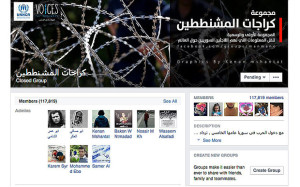
Traffickers use social media to market and sell fake passports and Facebook is a popular marketing venue, such as the Facebook page pictured here with 117,819 members that reporters have used to buy fake documents.
Reasons Why Fake Syrian Passports are in Demand

There are multiple reasons why fake passports are in demand and being created, resulting in such a booming organized crime business.

For Terrorist Acts

A key one is that threat groups need such passports for terrorism-related purposes. These passports are the most sophisticated and essentially are undetectable in terms of documentation because they are official in the sense that they are created with official government tools. Only the holder thereof knows he or she is not the person named on the passport.

For Terrorist Financing

Threat groups also issue passports to send their people out to other countries for terrorist financing purposes. The most compelling story of this occurring was the situation whereby ISIS’ leader, al Baghdadi’s wife had a fake Syrian passport (she is Iraqi) and lived in a refugee camp as a false refugee claimant in Lebanon.

For Access to EU

Fake passports enable people who are truly or falsely claiming refugee status to rapidly become a Convention refugee in the EU and obtain benefits, including the right to work.

The trafficking in fake Syrian passports is so effective, that many foreign nationals from poor countries who are not refugees, are leaving their own countries, entering Syria or Turkey, obtaining fake ID and then departing for the EU in order to gain access as a Syrian refugee.

Economic migrants use the refugee crisis for admission to the EU. The EU has said that nine out of ten refugee claimants who enter Serbia from Macedonia claim to be Syrian refugees and seek refugee protection but are not Syrian. UNHCR has said that out of the nearly 400,000 people who entered Italy and Greece in 2015, only half were refugees from Syria. Many are economic migrants from other places.

For Employment and Shelter

Fake passports are sought and bought by real refugees because they do not have any identity documents and believe that using fake documentation will assist them enter another country. Having official documentation is a condition precedent in many host countries for refugees to rent an apartment, get a job and send their children to school. Some do it for survival.

Refugee fraud threatens international security

There is not enough humanitarian aid to go around and abuse of the system from criminal activity means legitimate refugees fleeing terrorism suffer from increased poverty and lack of essential services.

Frontex is Concerned

There is a good interview (en francais) with the Director of Frontex, Fabrice Leggeri, below, regarding migrants, refugees, illegal immigration and the problem of TCOs selling fake passports. He says:

  • There is an increase of 175% in the number of irregular migrants who crossed borders into the EU in 2015, compared to 2014.
  • In 2015, 340,000 people who were irregular migrants with fake identity, were detected in EU. Many more were not detected.
  • There is a system of saturation of the registration system for refugees and migrants in the EU and thus, not all can be registered.


Leggeri : “Tous les migrants ne sont pas… by Europe1fr

Developer sued for taking proceeds of crime from foreign nationals

By Christine Duhaime | October 18th, 2015

New York real estate developer being sued for $18 billion for accepting alleged proceeds of corruption from foreigners who were known PEPs

According to an article yesterday in the Wall Street Journal, real estate developers in New York are being sued for accepting proceeds of corruption from politically exposed persons (PEP). The plaintiffs are the parties who were the victims of corruption – a municipality in Kazakhstan and a bank of Kazakhstan, BTA Bank. They filed a civil claim against two men accused of removing $40 million from Kazakhstan and parking it into real estate in New York City.

Both accused are politically exposed persons – one is the former chairman of the BTA Bank, Mukhtar Ablyazov who is in jail in France, and the other the Mayor of the Kazakh city of Almaty, Viktor Khrapunov. Allegedly, they removed billions from Kazakhstan as proceeds of corruption.

The plaintiffs are also suing an American real estate developer, Joseph Chetrit, for accepting the alleged proceeds of corruption and allowing the funds to be parked in real estate developments. The plaintiffs are seeking $18 billion in damages.

To read more about Mukhtar Ablyazov and the billions that apparently vanished from BTA Bank, see here. He is implicated in the biggest fraud case in the UK and was ordered extradited to Russia and the Ukraine after he fled from the UK mid-trial in 2012 and went into hiding in France.

UN Chief charged in money laundering bribery scheme for allegedly accepting millions in cash from Chinese casino billionaire

By Christine Duhaime | October 8th, 2015

Former UN President Charged

The former United Nations (“UN”) President of the UN General Assembly, John Ashe, the UN Deputy Ambassador, Francis Lorenzo, a Chinese foreign national billionaire, Ng Lap Seng (also known as David Ng) and two of his associates were charged in New York with various offenses over an alleged bribery scheme. Two defendants were charged with money laundering. According to the criminal complaint, the UN President accepted over $1 million in bribes from Ng Lap Seng in exchange for supporting his Chinese business ventures. He used the money for a BMW, Rolex watches, vacations and expensive clothing.

Moving Bulk Cash from China

Ng Lap Seng was earlier charged in the US with lying to immigration authorities when he brought in $4.5 million in cash from China over a two-year period. He moved vast sums of cash from China to the West by carrying it with him in bulk cash in private jets. Allegedly on March 6, 2014, Ng flew to JFK with $300,000. Then returned again on April 18, 2014 with $300,000 and again on June 13, 2014 with $390,000. After that, he started to land in Alaska, once with as much as $900,000 in bulk cash before transferring to New York City. Ng is the co-owner of a Macau casino, the Fortuna.

Facilitated Money Laundering

According to the allegations contained in the Complaint, Ng Lap Seng and his associates in China facilitated the transmission and laundering of over $1 million of bribery money from sources in China through wires from banks in China that were paid to the UN chief.

U.S. Attorney Preet Bharara said that if proven, the charges will confirm that the cancer of corruption that plagues governments infects the United Nations.  “As alleged, for Rolexes, bespoke suits, and a private basketball court, the President of the UN General Assembly, sold himself and the global institution he led.” The US Attorney said his office would continue to look at the UN.

Sibos 2015 — Reinventing Financial Regulation & Financial Inclusion

By Christine Duhaime | September 1st, 2015


Re-Writing Financial Regulation

Risk and innovation don’t always go well together.

If banks, regulators, lawyers and companies involved in emerging FinTech could re-write financial regulation, including anti-money laundering and counter-terrorist financing regulation globally, what would it look like? What should stay, if anything and what’s missing? Should we give a pass to emerging FinTech, payments and remittances or make them participate in the financial services sector on a level playing field with banks? Would it stifle innovation if we did that? What about financial inclusion – should we relax AML laws to undo the onerous effects of AML laws that contribute to financial inclusion problems?

Those are some of the issues that will be discussed at SWIFT’s Sibos Conference 2015 on October 13, 2015 in one of the most interesting and thought-provoking panels at the Conference.

Panelists

The panelists are:

  • Hamilton Ray, Founder, Collective Next
  • Bernard Wee, Executive Director, Financial Markets Development, and Payments, Monetary Authority Singapore
  • Natasha de Terán, Head of Corporate Affairs, SWIFT
  • Anju Patwardhan, Group Chief Innovation Officer, Standard Chartered Bank
  • Christine Duhaime, Founder, Digital Finance Institute
  • Andrew Brown, Global Head of Compliance & MLRO, Earthport
  • Akhtar Badshah, PhD, Chief Catalyst, Catalytic Innovators Group
  • Sean Park, Founder & Chief Investment Officer, Anthemis Group
  • Dan Kimerling, Co-Director, API Banking, Silicon Valley Bank

Financial Inclusion

We’ll also be participating in two sessions on financial inclusion, including one that will discuss the Refugee Bank, the first initiative in the world to address financial inclusion for refugees and migrants and to bank them institutionally, which is a project we started at the Digital Finance Institute.

Panelists

That session’s panelists are:

  • Kosta Peric, Deputy Director, Financial Services for the Poor, Bill & Melinda Gates Foundation
  • Christine Duhaime, Founder, Digital Finance Institute
  • Sam Maule, Emerging Payments Practice Lead, Carlisle & Gallagher Consulting Group, an NTT Data Company
  • Akhtar Badshah, PhD, Chief Catalyst, Catalytic Innovators Group
  • Daniel Marovitz, President, Europe, Earthport

Sibos is the pre-eminent global banking conference with upwards of 8,000 bankers, financiers and regulators in attendance. Come join the discussion at Sibos!

Digital Finance Toronto


If you want to hear more about the balancing act of innovation and regulation in North America, the Digital Finance Institute Toronto Conference on September 30, 2015 will also cover both financial inclusion and the regulatory issues facing banks, payments and FinTech companies.

Structuring – How Moving Funds from China to Vancouver Often Mirrors How Columbian Drug Lords Move their Money

By Christine Duhaime | August 31st, 2015

How is Some Money Moved from China? Often with Smurfs and Structuring.

I am often asked how Chinese foreign nationals who have immigrated to the US, China, or EU, or are attempting to, move millions of dollars in funds to other countries unimpeded when there are Chinese banking regulations (commonly called currency controls) that prohibit the removal of funds from China above a certain threshold.

The answer is that often they use a scheme called “structuring”.

Structuring is a well-known technique in money laundering law. It involves breaking down large sums of money to get funds placed in the legitimate financial system to avoid anti-money laundering reporting requirements (usually in amounts just below $10,000). It is also called smurfing because often many people, that in the trade we call “smurfs”, work together to complete the placement stage, namely, they make small deposits to avoid detection that fall under the bank reporting threshold. Not all structuring involves proceeds of crime, but all structuring involves manipulating the movement of money through many different people to avoid detection and hide the true transactor behind the transaction. And all structuring triggers the requirement in the US, Canada and the EU to file a suspicious activity report.

Structuring is a Well-Known Money Laundering Method

Structuring by smurfs is such a well known method that all national laws in respect of money laundering take that into account by requiring that banks look at placements over a rolling 24-hour period specifically to capture smurfs smurfing the system with proceeds of crime. Other anti-money laundering legal provisions, including those dealing with third parties conducting transactions for others and the requirement to report suspicious activities such as structuring and use of third parties, are designed to identify and eliminate smurfing.

Criminals with proceeds of crime usually desire to move funds from one country to another, thus there is routinely an international wire transfer involved after placement (when all the smurfs have made their deposits) to quickly get the money exported and into the bank account the criminal has in another country. In China, politically exposed persons sometimes have proceeds of corruption that they want to remove quickly to a safe haven. Vancouver is sometimes viewed as a safe haven for Chinese foreign nationals who have proceeds of corruption. In anti-money laundering law, politically exposed persons (“PEP“) and private banking clients are both supposed to be given greater, not lesser, scrutiny.

How Structuring Is Used to Move Money

Let me give you a real example from a FBI case in the US that involved microstructuring. Microstructuring is structuring only with micro payments.

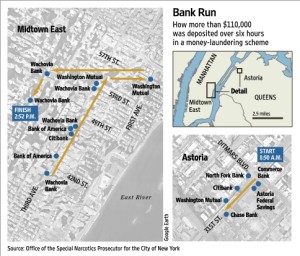
On March 15, 2006, in New York, Columbia drug lords ordered the microstructuring by smurfs of 112 deposits into several bank accounts. The drug traffickers in New York had to find a way to get the proceeds of drug trafficking to Columbia, so they decided to structure to avoid bank reporting requirements. The way it worked was that between 8:50am and 2:52pm, the drug trafficking smurfs in New York City made numerous cash deposits of US dollars in the range of $500 to $1,500 from drug trafficking revenues into banks all over Queens and Manhattan. In the space of a few hours, they deposited $110,000 in drug proceeds in various banks.

The Columbian drug cartel then used ATMs in Columbia to withdraw the funds in Pesos and the laundering cycle was complete. At the height of its activities, the cartel moved close to $2 million from New York to Columbia by microstructuring.

Structuring is Criminal

In 1986, structuring was criminalized in the US and in the year of this case, one office in New York alone indicted or convicted 25 people for the offence of microstructuring. The IMF estimates that between 2% and 5% of the world’s GDP — between $962 billion and $2.4 trillion is laundered worldwide every year. Authorities rely heavily on banks, which are required to report all cash transactions of $10,000 or more and to institute “know your customer” procedures to ferret out money laundering. Money laundering schemes are complex, employing layers of transactions, like structuring, to move money through multiple countries to obscure the trail of funds.

In China, structuring and the use of smurfs is as commonplace as in other jurisdictions only its most prevalent variety involves the skirting of Chinese banking laws that control the removal from China of more than $50,000 annually by Chinese citizens.

Structuring Scheme

In China, structuring is sometimes used.

Under a structuring scheme employed in China, a Chinese foreign national (who I’ll call the Evader) pays multiple smurfs (third parties) to use their bank accounts in China temporarily and file false bank remittance application forms.

The Evader transfers $50,000 into each smurf’s bank account in China. The smurf in China then completes a bank remittance application form to wire the $50,000 from China to Vancouver ostensibly for themselves as the declared remitter and “owner” of the funds, when it fact the funds are being remitted secretly for the Evader who is deliberately structuring multiple financial transactions using the global financial system to avoid detection.

The Evader locates and pays as many smurfs as are needed to act as the remitter of $50,000 to equal the amount she or he wants to export from China. The Evader has to pay each smurf a fee for agreeing to participate in the scheme.

Structuring can be a Money Laundering Conspiracy

Structuring schemes are well-planned and organized money laundering conspiracy (where it involves proceeds of crime), and can be a form of banking and government fraud in China, depending upon the circumstances. The conspiracy is to break the law and to abuse the international financial system to effect the removal from China of funds that are prohibited from removal by the person as a matter of Chinese policy. Those policy are in place to, inter alia, protect the Chinese economy and stop the enormous outflows of proceeds of corruption from China.

Structuring Hides Real Person Behind Financial Transactions

All structuring is designed to avoid detection of the real financial transaction that is occurring (the movement of a larger sum of money by one remitter, the Evader) by anti-money laundering compliance personnel and computer systems and to circumvent banking laws that protect our global financial system from financial crimes.

There is a litigation in Canada involving an employment matter which describes how a wealthy Chinese foreign national who immigrated to Vancouver structured many transactions through a Canadian bank. The judge in that case made a finding of fact that a Vancouver bank employee was aware of structuring from China by the client to avoid Chinese law, and facilitated the structuring activity.

The case is illustrative because it provides an example of a real case of structuring from China to Vancouver. In the case in question, the bank had a rich client who wanted to buy a luxury mansion in Vancouver for $5.7 million.

Chinese Banking Regulations Control Remittances

As noted above, banking regulations in China prohibit the removal of more than $50,000 annually by a person to any country, subject to some exceptions that require approval of the government. Chinese foreign nationals in China do not exercise the exceptions because they do not want the Government of China to be aware that they have wealth and that they intend to remove it from China to Canada.

According to the litigation case in question, the bank employee who was terminated, merged the wires into the Evader’s account so that the funds could be sent to a law firm as one transaction so that the wealthy Chinese foreign national who immigrated to Vancouver could pay the deposit for her mansion through her law firm. No one informed the law firm that its trust account was being used to receive structured funds.

Bank Employee who Apparently Ignored AML Law

In the litigation case in question, the judge explained that the wealthy foreign national from China needed ten different smurfs in China to send $50,000 each to ten other smurfs in Canada but could only find eight smurfs in Canada willing to accept $50,000 for her. In the middle of the night, hours before the deposit was due for her luxury Vancouver mansion, she called a bank employee and asked the bank employee to act as a Vancouver smurf to receive the funds. The employee thought there was nothing wrong with participating in a structuring scheme or allowing the bank to be used for that purpose, so she agreed.

The employee’s role, however, was disturbing from an AML compliance standard. The employee in question was well-versed in AML requirements because she was a licensed investment advisor and accountant, in addition to being a bank employee and had, in that sense, triple the AML reporting obligations. Despite that, she did not tell the bank about the incident and it is probably safe to assume that the employee likely did not file a suspicious transaction report for the structuring activity (part of which involved her bank account when she acted as a Vancouver receiving smurf), the use of third parties, and the activity to evade Chinese banking requirements.

In anti-money laundering law, a suspicious transaction that requires reporting includes a transaction conducted to conceal funds, inter alia, to evade any law or regulation, including a foreign one, or one that has no apparent lawful purpose.

No Lawful Purpose with Chinese Structuring Schemes

Structuring schemes are suspicious in the classic money laundering sense because they are designed for the sole purpose of evading banking laws and clearly have no lawful purpose in fact everyone knows its purpose is unlawful because that is the whole point, namely to unlawfully remove more than $50,000 from China by structuring to hide the fact that it is one person remitting the funds to Vancouver.

Nigeria says US$150 billion stolen from state coffers in 10 years by politically exposed persons

By Christine Duhaime | August 9th, 2015

Whopping $150 Billion Stolen from Nigeria in 10 Years

Nigeria’s new President, Muhammadu Buhari, today said that the government believes that its officials have stolen approximately US$150 billion from the state in the past ten years.  In anti-money laundering law, high ranking government officials with access to state property and assets are politically exposed persons (“PEP“). Every penny of the US$150 billion is proceeds of corruption or theft, hence laundered funds.

The Money Laundering of 1/3 of Economy of Nigeria

To put it in perspective, US$150 billion is almost one third of the whole value of the economy of Nigeria. The Government of Nigeria is effectively saying that approximately 1/3 of its economy has disappeared overseas in corruption payments or outright theft, into the bank accounts of private persons – in this case, PEPs and 1/3 of its economy has been laundered out.

PEPs

PEPs are a high risk for financial crimes, such as money laundering, tax evasion, corruption and terrorist financing because they have access to large sums of financing and the political power and banking relationships to launder money to offshore locations for their personal benefit. All banks in Nigeria, including Western banks, are required to undertake proper enhanced due diligence in respect of all PEPs to ascertain that any assets and money they deposit and move is legitimately earned, otherwise they are required to de-risk and terminate the accounts.

“Mind-Boggling” Assets Stolen in Oil Sector

President Buhari also disclosed that “mind boggling” sums of money had been stolen from the country’s oil and gas sector, which accounts for 70% of Nigeria’s national revenues. Likely by PEPs. Nigeria is the largest producer of crude oil in the region. President Buhari said that the government would engage professionals to undertake asset recovery of state assets and recover the assets.

Nigeria Conducted Business with Non-Government Bank Accounts

President Buhari said that up until now, some official government business had been conducted using non-government bank accounts, suggesting that PEPs and government agencies in Nigeria use personal or private company bank accounts to conduct official government business on behalf of Nigeria.

Effective today, every government agency in Nigeria has been ordered to use only government bank accounts to conduct government business. The order is designed to introduce transparency into Nigeria’s government financial transactions and to stop so-called “leakage” – a polite term that refers to corrupt and other payments made under the table.

‘Twitter terrorist’ a danger, says panel at ACAMS Conference

By Christine Duhaime | July 17th, 2015

The Lawyers Weekly has a good story covering the ACAMS Conference in Toronto’s panel on terrorist financing in which we participated with FINTRAC, Standard Chartered and the OPP to discuss the risks and issues of terrorism threats in Canada.

The article, available here, discusses Ontario and security concerns, as well as how FINTRAC deals with terrorist financing reports, with coverage on how the Islamic State uses social media for recruitment and financing efforts. It also summarizes risks, including how a certain Bitcoin online exchange advertises that it offers services in Syria with the use of bank accounts from Canadian and US banking institutions.

As noted in the article, ISIS’ social media efforts represent a major threat to Canada.